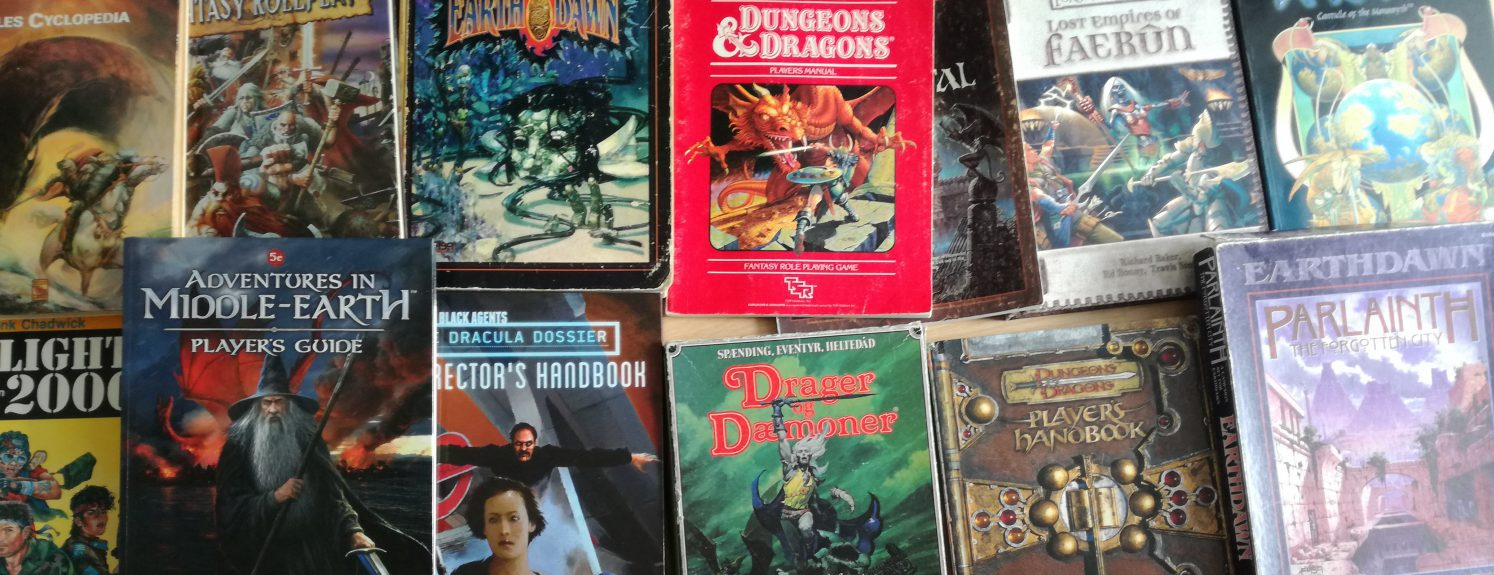
I want to provide context for my posts on rules and campaign setting, and I’m writing brief overviews of each session for my players anyway, so I’ve decided to post the chronicles of my campaign on this blog. With my Warhammer campaign coming to a close at around 90 sessions, where I have a few paragraphs on each session, I can see it is also a pretty cool thing to have when looking back at all the great fun we had.
Campaign setup
My campaign is fundamentally an exploration campaign. The realms of the East have been warring for 30 years against a dark empire named the Hrran Hegemony. The war is in a deadlock and the ‘good’ realms need resources, allies or some kind of joker to break the deadlock. Fortunately, the half-elves of the Isles of Finrod have found a new continent across the ocean. The largest human kingdom therefore sets up an outpost and has sent settlers there to establish a new realm, and to explore the lands for riches, magic and potential allies. The characters are among the second group of settlers sent there.

The Group
All members of the adventuring group come from the realms in the East, which have a geography and technology roughly equal to early medieval Europe. They decided at the beginning to form a accredited Adventuring Company, which provides some advantages, but cost them resources.

After 3 sessions the line-up is:
Sir Jarn Ashford, Human paladin 1/ranger 2
Arak, half-orc fighter 2/war cleric 1
Welk Del’mantanrese, human abjurer 3
Weylyn Cullain, half-elf moon druid 3
Horziver Xalybyr, gnome arcane trickster 3
Abbott, human warlock 3
Korrick the Lorekeeper, dwarf fighter 1/bard 1
The first 3 Sessions:
Session 1:
The members of the adventuring group has various ties to each other, both are mostly not close friends. They embark on their journey at the Isles of Finrod, and sail across the ocean on one of three vessels (of course). After a few weeks they make a stop at Hope’s Pinnacle, which is a lone island with a huge abandoned castle built by giants, where a garrison and port has been built by the good nations. They stay a couple of days before continuing their journey.
Close to land the ships are thrown into a storm and attacked by Kuo-Toa. The party fights them off, but after the storm dies down one of the three ships are missing.
Meta: They drew random questions I had created, which they answered to create more backstory for their characters.

Session 2
They arrive at the small settlement, which lies in a cove, next to a river, surrounded by a vast forest, and with a couple of gleaming white towers reaching above the canopy in the distance. They are greeted warmly, and introduced to some of the people living there, including the governor Erin de Vrin. But with a missing ship, the mood has a somber undertone. Next morning, the two adventuring parties available to the settlement are sent out to find the missing ship. The characters are sent north, while their ‘rivals’ are sent south.
The group treks through the forest and at night are assaulted by a Displacer Beast, which they manage to slay. The following day they come upon a group of goblins, throwing stones and taunting a wounded elf captured in one of their pit traps. They drive off the goblins and rescue the elf. The elf has tattooed camouflage on his skin and he almost only use sign language.
Session 3:
With some difficulty the druid Weylyn begins to communicate in the elven tongue with the tattooed barbarian, and recognizes that he speaks some kind of dialect of the elven language. They learn that a big winged beast roams to the north, and that he finds it very important to stay hidden. The next morning the elf has sneaked out of the camp.
Using the wizard’s seagull familiar, they do spot the winged creature, which turns out to be a wyvern, and see its nest in a ruined tower. They decide to explore the tower while the wyvern is hunting at dusk. At the top of the tower in the nest of flotsam and bones, they find a couple of scrolls and a kuo-toa body. Welk and Horziver figure out how to destabilize the nest, and make a plan for attacking the wyvern when it lands, and hopefully drop to the bottom of the ruined tower. The plan succeeds and the party manages to overcome the wyvern without getting hit.
At night, the carrion crawler that had hidden in the tower came out to feast on the wyvern. It was discovered, and the group killed it.
Trekking further north they finally come upon a cove, where the lost ship is stuck on a reef. The cliffsides have many cave entrances, and they begin to explore. They find a body of a sailor, after chasing away two giant crabs, and in one of the caves they are attacked by many crabs, but rescue an exhausted guard from the ship, who hid in the cave.
They bring her back to their camp, to give her rest and hear her story. At night kuo-toa emerges at high tide from one of caves and sacrifice a human to some kind of snake creature that emerges from the sea.
Meta and Mechanics note:
Fighting the wyvern, the damage output of 6 players was very high, with above average rolls, and it was a short

encounter. But the danger of getting hit by the poison stinger of the wyvern made it a tense encounter. It certainly displays the weakness in D&D 5th if you have large groups against single enemies. However, in this case, a hit by the wyvern on almost anyone of the 2nd level characters would either drop or kill them. I think it was fun, and when the PC’s dare something dangerous, the player’s feel great when they succeed.


 mindlands