Session 11: A big signal fire

The game session became a sort of ’in-between game session’, where the group finished looting the dungeon, met the local elves and had a long talk with them for the first time, and got into another big fight with the undead, where the power of the Staff of the Woodlands was demonstrated.

I’ve also been looking at making a post about magic items, and how you can make the discovery of powers progressive, spurred by the comments in for the last post (here The last post), but I haven’t had enough time to finish it.

Events of the session:

At the end of the previous session, the group had killed the aberrant plant monster that lived in the ruin, and they commenced looting and exploring the final sections. They went outside a couple of times, but neither the ranger nor druid passed their wisdom check, so they failed to notice something important. They discovered a statue of an elf, which held out a stylized map with a mountain chain with the mark of the throne on it. They found a secret room with treasure, including 50 pounds of iron and finally a room where dark seeds of the abomination were grown. They decided to burn the seeds, but the group was low on resources and had no fire magic left, so Arak, the strong half-orc cleric and Jarn, the ranger and leader, goes into the forest to get firewood. That is when they see the column of smoke that rises from the pyramid from all the burn vines inside the dungeon. They drop all the collected firewood and race back to the pyramid (I must say I liked this moment, when it dawned on the players what their actions meant).

The wizard’s familiar, Steven the sea gull (pun intended), is sent out to scout and Arak stands guard on top of the pyramid. Steven spots a large-ish band of goblins heading towards the pyramid, and Arak actually notices one of the local nomadic elves hiding in a tree. As the group is low on HP and spells they decide to retreat. After a while they make a short rest, the druid gains access to ‘pass with out trace’ and they escape the goblins, who spent some time scouting the ruin (if the characters had decided to stay other interested parties would have shown up, which would have been all kinds of fun!).

dead undead
I’ve never regretted getting the undead army for Warhammer Fantasy Battle back in the mid 90s. Those minis have been used countless times! 

After escaping the goblins, on their way to the place where they met undead the first time, they are attacked again by a group of more than 20 undead, marching towards them. There is a 5th level spell caster and the equivalent of a boosted Wight among them. It turns out that even though skeletons aren’t that dangerous to 4th level characters, if enough attack, they become a problem…

This is where my concern from last time, concerning the Staff of the Woodlands, was partly laid to rest. The druid use the Wall of Thorns spell from the staff and kills 6 skeletons with it, and a further two are pushed into the wall with a Gust of Wind spell. It doesn’t break the encounter at all, but it takes it down to a more manageable level. They are still under a lot of pressure, but they survive. If he had used it on the two ‘bosses’, they would take significant damage, but wouldn’t be killed outright. Obviously, in open terrain it is less effective than in a dungeon, where you can seal off passage ways.

The leader, who seems to be an undead orc with a magical scale mail, has a message crystal (like a simple recording device) with the following message:

“Deploy your companies north west of the city, and keep our lines of communication open with Fort 25. Commander Osandros will deploy to the south towards the Colorless Bridge. Reinforcements will be allotted as they arrive. This is the order of Belsokh Six Fingers. For Sarakhon!”


The characters who have been studying the books they found in the hag lair, recognizes Sarakhon from the name of the enemy an elf led an army against – they were called The Bones of Sarakhon.

The next day they locate the cave where the undead came from, and where they had been lying for several centuries. They also find a copper sheet, with an etched map showing the location of both Fort 25 and Fort 26 and the ruined city they’ve passed by earlier. They speculate that the undead were making war on the elves in the area long ago.

When they emerge from the cave, an arrow with a flower attached to it, is shot at the feet of Jarn. He shoots the arrow back, and a small group of elves emerge. They proceed with a trade, and then they begin talking. The elves clearly find their settlement unwise.

The group learns some important information though:

  • Hobgoblins live on the plains beyond the forest, and come into the forest to capture slaves. At some point, if they wish to live in peace, they have to deal with that threat.
  • There are many goblin tribes and they are sure to end up fighting them.
  • To the south lives Osganithmoth Suneater, an old green dragon, which fortunately sleeps right now, but its offspring infests the forest.
  • They watch over the ruined city, to guard against the creatures coming out of it. The demons that dwell within cannot get out though for some reason. Inside there are many monsters, among others a group of giants that wandered in from the hills to the south west.
  • They don’t have access to metal and are interested in trading.
  • They know of a source of iron, but it is a dangerous place.
  • The location where Fort 25 is supposed to be is a dangerous ashen wasteland.

When they were done speaking with the elves, we ended the session.
joseph__the_ancient__forest_dragon_by_mikeazevedo-d7jlys8

Perhaps Osganithmoth looks something like this… Scale seems pretty accurate! Art by Mike Azevedo. Check out more of his very cool stuff here: Link to Mike Azevedo’s art


Next time:

We will finally have an extended period of down time, and they can use some of the time to get to know more of the local inhabitants. It should strengthen their connection to the community and make them feel more a part of the settlement.

The campaign also opens up, and they discussed what should be their next target: the iron mine, fort 25 or the ruined city. They decided upon the iron mine, as it would be an important resource for the settlement.

Perhaps this will be our first session without an initiative roll…? But then again, maybe not…
 

Session 10: Too fat loot?

After our last session, where the main focus was the characters purging an aberrant plant monster from a dungeon inside something akin to a large stone foundation, my thoughts have centered around magic items and treasure.

the_old_huge_oak_tree_by_williamsnape-d3enn3q
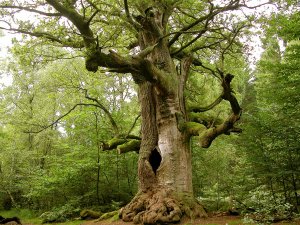
A planted Staff of the Woodlands – in my mindland.

At the end of the session, they discovered that this abomination had gained energy or the like from a tree, which turned out to be a Staff of the Woodlands (a Rare item). My idea was that the creature sort of fed from this tree and almost had withered it. Thus, my concern about the balance of the staff was secondary. But avoiding highly imbalancing fat loot, and avoiding a monty haul campaign, is important. But I have a few considerations that I need to take into account.

  • I have seven 4th level players, and currently four of them have a magic item that aren’t consumable: a shield +1, a Wand of Secrets, an Alchemy Jug and the Staff of the Woodlands. With seven players, I need to hand out quite a lot of stuff, before everyone feels overloaded with magical items, and thus many magical items isn’t unbalanced in itself. It is the fact that I have 7 players that makes the game harder to balance (so I kind of skipped balancing encounters to the party).
  • Remembering our old AD&D Forgotten Realms campaign from high school (the player playing the wizard Welk was the DM), which I enjoyed very much, magic items were relative scarce, but the ones we had were quite significant to our characters, so at 12th level I had maybe 3 permanent items. I really liked that, and I think it is worth emulating.
  • Staff of the Woodlands is on table G, and can be awarded at random at any level (although the likelihood in a 0-4 or 5-10 level hoard is low).
  • The staff has a limited number of uses per day. It has a number of abilities, including casting Wall of Thorns, which is a 6th level spell, and very powerful, but the Wall of Thorns takes up 6 of 7 charges. If I run one encounter adventuring days, it can be a problem. But I intend to have multiple-encounter adventuring days, which makes it more of a choice to use the power. Furthermore, as I’ve more or less ignored balancing encounters, it can be important for them to have a method of escaping an encounter or dividing an encounter into more manageable size, if they bite over too much. And as they only gain 25% xp from encounters, but additional xp from exploration, it matters less that they can handle more powerful creatures. The lesser powers, and the fact that it is a +2 weapon, will have much less impact on the story, but will be quite useful to the druid.

will mclean monty haul humor D&D cartoon

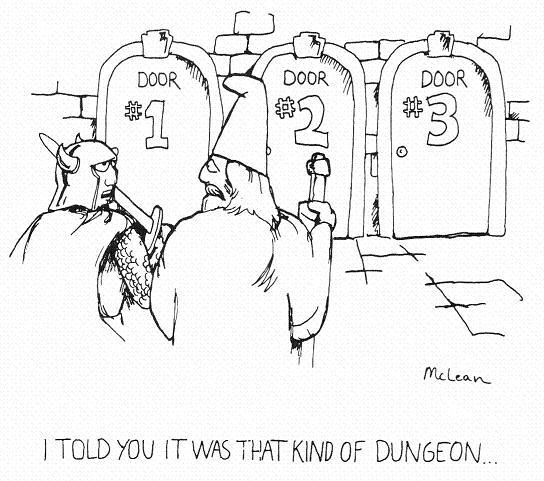
My preliminary conclusion is, that I would rather hand out a good number of consumable items and a few relatively powerful items, than scatter many +1 shields, armours, weapons and other uncommon items around the game. If each character has the chance of obtaining one Rare or better item from now and until 10-12 level, that is fine by me. Hopefully, some of these items will become important aspects of their characters, and help it become a memorable campaign of heroic characters. And hopefully, they don’t become too powerful and collapse the ideas in the campaign… We will see how it goes. It is a sand box after all.

And now for the short recap of last session:

Session 10:

mayan-pyramid-unexcavated-best
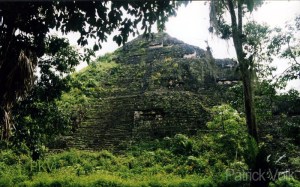
The dungeon was inside something akin to this – one of my players noted the Earthdawn feel to it. He was not incorrect…

The group discovers the inner laboratory of the witch they defeated in the previous session. Inside they find a number of interesting items, including some sort of silver rod, which appears to be a key to something, a portal to the Warrens (the world between the prime plane and the outer planes) and some ancient elven books. The druid and wizard begin deciphering the content of the books and advance their skill in the local elven language, and they decide not to open the portal, even though it is a possibility (the campaign could have taken quite a turn, had they decided to go through. I know where it leads, but prep is sketchy). Instead they went back to the ruins, with the sort of top less pyramid shaped structure, and went inside. The dungeon contained thick vile creepers that attacked them, and they burned their way through part of the dungeon, reaching the center, where an abdominal plant creature lived. They attacked its pulsating heart and overcame it, and found the Staff of the Woodlands at its heart.

Afterthoughts:

I had, by design, made several entrances to the dungeon, which meant they could clear out all of the abominations pods before they faced the creature itself. For each one they killed, it would have one attack less (minimum 2). It had a ton of damage potential, but it was one of those evening where I rolled poorly, so the group overcame a very powerful creature more easily than anticipated.

I look forward to them delving more into the books they found, and the campaign is opening up to a lot of options now.

It’s a witch! (They didn’t weigh her, or burn her) Our 9th session…

We had a really enjoyable 9th game session, where we managed to get closer to the kind of games that I would like to run, and where I (mostly) followed the ‘say yes doctrine’ for game masters. I also really enjoy the characters the players have made. I think they are a fun and dynamic group – and it works with 7 players, although it is hard to discuss plans where everyone gets their voice heard.

A few of the things that I would like to keep doing was:

  • When the characters get an idea, go with it.
  • If a spell or action seems like it should have an effect not written in the rules on a character or environment, go with it.
  • Keep the players guessing and hungry for information.
  • Keep making NPCs and monsters that fit with the story, and ignore the monster manual and rules (to an extent).

Events of session 9

In the session the characters met the elf woman, whom they suspected of being a hag, and notice that humanoid forms were inside the water, close to where they met her. After some conversation, where she confirmed that she had rescued the man-at-arms, Renald, and that they were in love. They exchanged information and they were invited into her lair, inside the giant tree stump, so they could meet him. They were very worried about giving information away, but as she did not speak any language that everyone in the group spoke, unified communication was a bit of a challenge.

Inside the giant tree stump, they can tell it is a big lair, with many rooms carved inside the tree, with platforms and bridges linking them.  Inside the hollow part of the stump was also a camp of almost a dozen lizardmen, who were her allies. After they’ve made camp, she came down with Renald, and they exchanged more information about the land around them. For example, that a great dragon lives in the southern part of the forest, that there are plains to the west with hobgoblins and somewhere north a forest made from crystal. They challenged Renald, as they saw it as his duty to return to the settlement, but some could see that he was conflicted, but refused.

When they went to rest, the group sort of decided to break their word to her, that they

lizardmen
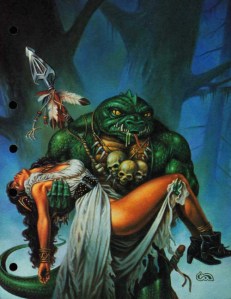
In this case it was a handsome male fighter who was captured. The picture reminds me of the only ‘real’ D&D modules I ran in elementary school. Can’t remember the name. It was 1-3 lvl. and about a kidnapped elven princess. Wish I still had that stuff…

would maintain peace with her, when they entered her home. They used the newly acquired Alchemy Jug, to produce 4 gallons of beer, and the half-orc, the half-elf druid, who could speak with them, and the dwarf bard, who added a wineskin of brandy to the mix, went and partied with the lizardmen, who, unused to alcohol, got roaring drunk, with a couple passing out, and all the while the dwarf bard is using his bagpipe to mask the noise with his…music. The group arcane trickster sneaked up on the lizardman guard, standing on a platform above the whole thing. His sneak attack fails, but the bard manages to conceal his cry for help with his music, and they manage to overcome the (neutral) lizardfolk.

Subsequently, the party crashes into the bedroom of the (almost), unsuspecting couple. The witch orders her man to protect her, while dispels the grease cast at her feet and turns invisible and flee further up the winding passageways of the tree. A battle ensues. It is a complicated affair, but they pursue her to a menagerie of strange beings,  including two cockatrice, a bear with poison fangs and a snake tail and a giant vulture. The hag, who finally shows her true self, tries to flee on the vulture, but is finally brought down, and the bear is killed as well, before we end the session.

Thoughts on the Encounter

All in all, a fun encounter, that highlighted the hag’s ability to deceive and spell bind. I ignored the rules as written about Charm Person, as I think it went against the story I had in mind (and why would people always know they’ve been under the influence of a charm spell? It seems pretty pointless to me then, unless it is simply to get past a guard or something). I also gave her more HP and spells, and plenty of weird pets, as a single monster quickly run out of HP against 7 PCs. As always, they also often had to make all kinds of saving throws (mainly Con). I think rolling a save highlights either a characters strength or weakness, and players either enjoy rolling something their character is good at, or dread rolling saves, when it hits one of their weak sides. This emphasizes the choices they’ve made in character creation, which I think is important.

vulture
A hag on a giant one of these, I think would be pretty dangerous and cool… 

It was wise of the characters not to take the fight up front, as outside, or flying on her vulture, her Call Lightning spell would have been a big problem for the 3rd and 4th level characters. I thought however, that her interest in learning more from them, outweighed her own caution of inviting an armed group into her home.


Next time, we will see what they find in the hags lair, and how the discussion about breaking their word ends up. Furthermore, the group has to figure out what to do next, as no one is there imposing another mission on them.

Session 8: Scorpion trouble and a shield

The session had a full group of 7 players, and it is very enjoyable, but naturally leaves less time for individual attention and combat takes longer.

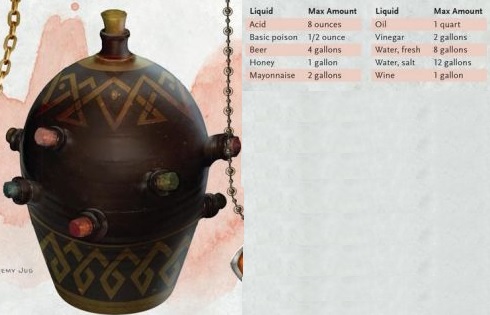
It began inside the small (randomly found) adventuring site the group discovered in session 7. They began the evening by identifying the treasure they found – a wand of secrets and an Alchemist Jug. The jug is actually quite a nice wondrous item, when you are in new settlement on a far away coast, as it can produce one type of liquid each day in various quantities, including water, mayo and honey.

alchemy-jug
The Alchemy Jug from the DMG pg. 150. 

I like the Wand of Secrets, as it helps me avoid the awful situation where players decide to search after secret doors in the right spot, but rolls too low on Investigation. Secret doors are fun when they are found!


Abbott – the strange warlock and noble son – also drew a question from my stack of background questions, and told us that his most significant memory from the war in their homeland was going through a village that had been pillaged and slaughtered. He declined to say, why that was significant…

From that point they travelled north, and I rolled an ambush in my random encounters, an Ettin in this case, who was arguing with himself. They relatively quickly dispatched him (80-ish HP doesn’t last long against 7 characters), and Arak cut off his heads and put them on a pole as a warning. The wizard, Welk, was a bit upset, as he spoke the language of the giants, like the ettin, and would have liked to gain information from him.

I rolled another encounter for the next day, and this time it was another minor adventuring site, and it turned out to be the lair of a huge giant scorpion with weird lichen and toadstools growing from its carapace. It was lurking in a large copse of toad stools with Shriekers around it. Down in its lair, they discovered a magical dwarven shield, with a throne marked on it, which confirmed to them, that there must be dwarves somewhere in the land they’ve settled in. They were also attacked by 6 scorplings, and was another reminder that 6 smaller foes – particularly when they can grapple and poison you – can be much harder to deal with than one large foe. The encounter had several of the players below 0 HP.

The next days of the journey was uneventful, and Korrick the dwarf bard and warrior, got to tell them, how he was accompanying a dwarven expeditionary force  as a record keeper, when they were ambushed, and he was forced to pick up arms and become a soldier. Eventually, they found the old track of the lost man-at-arms,and followed it to a large ruin where a lot of colorful flowers and toadstools were growing. There were many low ruins, but the main one looked almost like a base of a meso-american pyramid with several entrances in it and vegetation growing out of it from within.

Swamp
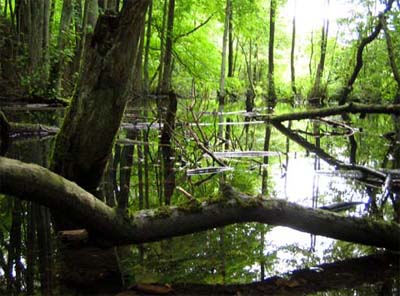
A dark dank swamp – always a nice place for adventure… 

They found two sets of tracks leading away from the ruin and decided to follow the track instead of going into the ruin, which they wanted to return to later. Some miles from the ruin the area became more marshy, and they saw charms in the trees and elven runes in the tree, which they translated into warnings of an ancient fey creature living in the area.

Jarn, the nominal leader of the group, could tell them of how his order once fought a coven of hags, and how badly that went, and that they can take the form of other humanoids. After some deliberation, they wearily decided to move forward and find a small swamp with a 150 foot tall tree stump growing in the middle, which is clearly the home of someone.

Next session is tonight! I look forward to seeing how they approach this challenge?


Session 7: Let the Hexcrawl begin!

My firstborn arrived last week. I now hope to raise a girl who loves games! Time will tell if she will play role-playing games like her dad. Her arrival means a temporary suspension on my bi-weekly game, but my brain – despite being sleep deprived – is still overflowing with ideas for my campaign world. The challenge will be getting the time to write them down. Part of my current inspiration comes from watching a great blind Let’s Play of Dark Souls by the gamer Kay Watch Kay plays Dark Souls while I cook baby bottles and the like. I enjoy her focus on the lore, which I didn’t dive as deeply into when I played it, and it stokes my brain.

The Session:

The session started after the group defeated the undead that attacked them in the

isle of dread DM map
My own first hex crawl experience was on the infamous Isle of Dread with my first ever RPG character, the thief Falvin. Unfortunately, we only had one session on the island…

previous session. We spoke out of character about how each character probably experienced the last encounter, and consequently what they might suspect the wizard to be carrying in his backpack, which the undead sorcerers were clearly interested in (I chose this approach to avoid differing perceptions among the players creating disruptive conflicts in game. Conflicts between characters can be great, but they can be difficult to handle if players aren’t reasonably aligned on what is happening in the game, in my experience).

After some in-game discussions of the events, no big conflict erupted, as the gnome rogue was concealing the item the undead were after, but Jarn suspects that the wizard Welk has demon-summoning spells in his grimoire, or the like. The group was smaller than normal, and they decided not to investigate where the undead came from (to my surprise).

They continued back to the settlement, forded a rapid flowing small river and encountered a glade with a huge butterfly swarm. Jarn, who scouted ahead, felt tired when they landed on him (exhaustion level), but nothing happened. The druid investigated, and found a sleeping doe in the glade, but nothing inside the glade was dead.

After several days they finally reached the settlement, and were greeted as heroes. The new arrivals had settled a bit, with the tavern being open under a large piece of sail cloth. They reported back to the governor, and staked out a site for their home (more on that in a future post). They also got a scroll that could heal the wizard’s burnt lungs and remove his exhaustion level.

After some deliberation, they decided to go back north to find the lost bodyguard, who’s trail they were on. They skirted the massive ruined city nearby, and could see that it had been under siege long ago, and that walls and a tower were breached, but that one breach was sealed by a massive wall of fire.

A few miles from the city, they found a small ruin with a hidden staircase to a cellar (random adventuring site). In the cellar there were three rooms, one was empty, another they had to hack their way into as it was blocked by giant mushrooms, and a giant constrictor was lurking inside, and the third they had to dig free. The third room turned out to be a wizard’s laboratory, and a strange stitched creature was huddling in a corner. It was indeed a flesh golem, but the four characters managed to defeat it without too much trouble, and they discovered 2 magic items and some potions and loot.


IMG_1232
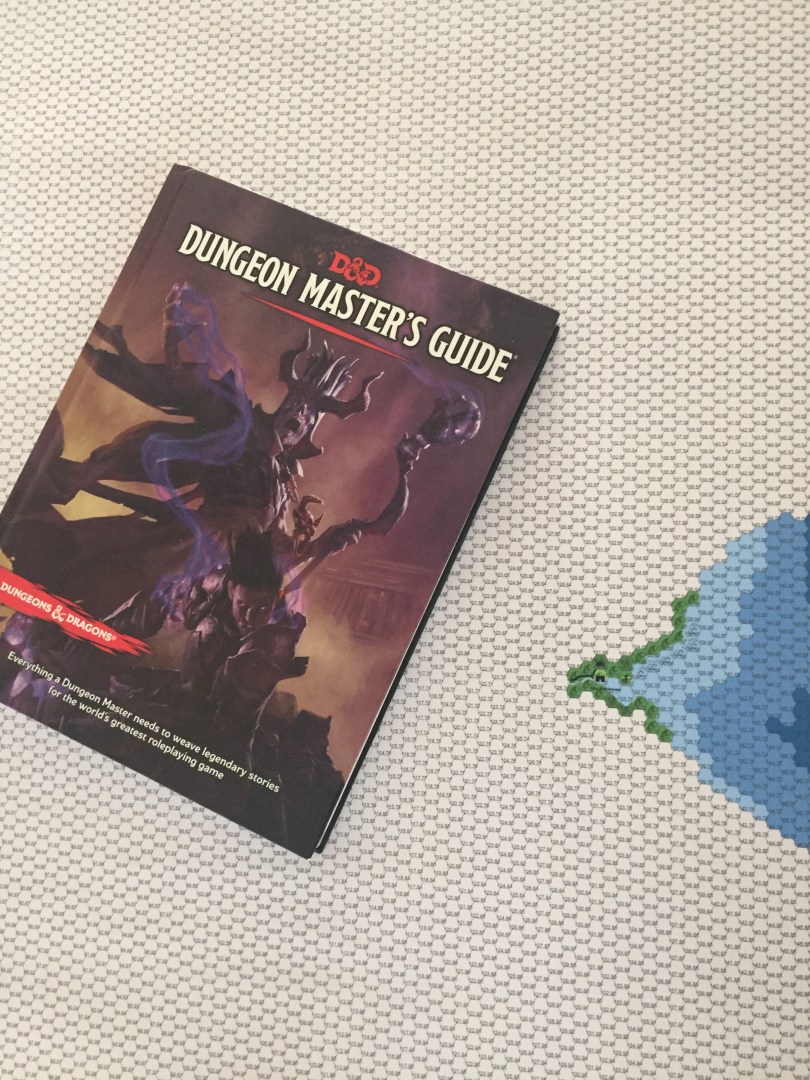
A major part of the map, with a small area filled out in advance for the players.

Hexcrawling:


When the group returned to the settlement I brought out my largest handout to date: a copy of the map I have done using Hexographer (http://www.hexographer.com/), but with more than 99% blank. The map contains 22500 numbered hexes, and I have no ambition that this campaign should reveal even a significant proportion of them. I hope that by providing the blank map, it will inspire them to go and explore, have fun annotating the map, and that it will provide a sense of accomplishment, when they reach new land marks and fill out hexes.

As my players read this blog, I unfortunately can’t share the original…

One thing is pulling in a different direction though. The huge ruined city I placed close to the settlement has a magnetic effect on the players, and I think it will consume many sessions going forward. A lot of my current thoughts are going into how I will run that ruin, and what is contained within. Currently, I’m working with an approach like the Parlainth box set from my beloved Earthdawn game (A Black Gate post on Earthdawn), where each section of the city has certain characteristics, but aren’t mapped in detail (unlike e.g. the Ruins of Myth Drannor box set from AD&D). I think I will add – if I can find the time – random encounters to each section and a few significant land marks. And improve my winging ability…


D&D Session 6: Random Encounters (or is it?)

Wednesday we had one of the best sessions of the campaign so far. The characters have to make their way back to the settlement with the seven survivors of the wrecked ship. It is a week-long trip (at least), and here is where my extensive list of random encounters, locations and events comes into play.

It is a topic I’ve been reading about on the excellent DM David blog (for example: http://dmdavid.com/tag/three-unexpected-ways-wandering-monsters-improve-dd-play/) and I’ve used the same approach without fully realizing all the advantages. One advantage is that the random encounters create a real sense of threat when travelling, but they can also be a reward for exploring, by adding wondrous and strange locations with potential treasure and lore.

I’ve decided to post the random encounter table  below, where my players can also see it.

Knowing the rules and being able to make decisions based on rules is already a core part

wilderness survival
I want wilderness exploration to be fun, rewarding and to drive the plot forward.

of D&D. Having a mechanical understanding of the encounter system can add a level of tension and excitement in my view. It should add depth and interesting discussions when the players understand the dangers and potential rewards of travel into lands where they don’t know what awaits over the next hill.  It is certainly much more interesting than players with meta-knowledge of the monsters, which is why I alter monsters in almost all encounters in a meaningful way.

Session 6:

The game started after their hard encounter with kuo-toa. The half-orc Arak buried their casualty, while their aspiring leader, Jarn, tries to instill some confidence in the surviving NPCs without much luck (his character is only 16 years old, so that seemed very reasonable). They move their camp away from the carnage and successfully gain a full nights rest while scavengers of the forest fight over the kuo-toa corpses. In the morning they decide to split up (I don’t know how they dare…?). The ranger and druid will try to follow the trail of the final survivor of the ship wreck – a bodyguard of the royal envoy –  a little longer, and return to the group before nightfall, as they travel much quicker in the forest. The rest of the group with the NPC survivors travel south.

The druid and ranger follows the trail, find a goblin trap the bodyguard walked into. A little later they find a pink giant mushroom that glows (random encounter), and avoid it out of fear. Finally, they find a place where he rested and were set upon by a goblin hunting party who followed his blood trail. He managed to defeat them, but retreated further into the woods. The two characters decide to turn back and catch up with the rest.

The main group reaches a wide gorge (random encounter), which is basically a skill challenge, which they can decide to forego and spend an extra day travelling, or attempt, where failure means a longer delay. They attempt the skill challenge and manages easily (natural 20), to get all the people across the gorge.

They camp and the ranger and druid catches up with them.

The next day I decide that the next time I roll a random encounter, I will introduce a significant random encounter that has a plot relevance. That happens the second night. They camp on a large cliff, and during the night the wizard is haunted by nightmares. He awakes with the sound of claws on rock and seeing empty eye sockets. He immediately casts a spell, and the two characters on guard notice that something is coming up the cliff.

943328-lich
The undead had many game features which interacted well with player abilities.

Combat begins with 15 skeletons and two undead spell casters (5ht level sorcerers) arriving a round later. The plot hook is that they are after an item which the wizard has brought to the new lands (or more accurately, fled…). The two sorcerers are have cast fly, and are only interested in that item, and attacks the wizard. When they defeat him, one of them lands and grabs his backpack. The rest of the combat the undead tries to get away with the item, the fly spell fails however, and the gnome arcane trickster (who helped “procure” the item in the first place), manages to get the item out of the pack. Ultimately, the group defeats the undead, and that is the end of the session.

Next session will feature some pertinent questions for the wizard, and perhaps exploration of where the undead came from. And more travelling and random encounters!

Thoughts on the session:

Several things worked well. The random encounters, and the combat situation were fun and added a lot of flavor. The players were challenged and surprised by the dispel magic and other spells the undead cast. The combat was quite dynamic and tactically interesting, with various spells such as darkness and fog cloud used to protect the NPCs and characters. It worked almost as a game of ‘tag!’ and everyone played an important role.

I also use a bunch of notes with written questions to the characters, which players draw at random, typically when they’ve camped. Questions like: Who do you know who’ve been killed in the war? And: What is your fondest childhood memory? The first question came up in the session, and was great characterization for Jarn Ashford III.

The fact that there had been random encounters meant that the players seemed initially unaware that there was a plot reason for the combat. I really like that. Keeping players uncertain of what is planned and what is random I think will create a very interesting campaign. The players won’t feel the same inclination to go with what the DM presents, because they assume that it is where the plot is leading them, but will go with what their characters desires and thinks (I hope).

The random encounters also add fun for both me and the players, as I won’t know how the session and story will turn out either. I need to add a few things though: more lore connected to the world in the encounters, either via minor sites of interest or NPCs. I should also add actual random events/encounters with deeper plot hooks.

I also need to introduce rules for disengaging/fleeing from combat, as D&Ds movement rules are not useful for that. As there are overwhelming encounters on the list, there has to be a way to also withdraw or flee.

I need to add encountering NPCs to the list, to add variety to the list.

I have to keep being patient and let each session play out at the pace the dice dictates.

The Current Encounter Table:

This is the current encounter table I use. I’ve removed specific names from the list to avoid spoilers for my players. I try to include the distance of the encounter in the encounter description instead of having a separate random table. There is also another list with random monsters for the area they are in, when I roll 7, 10 or 13.

Encounter chance per day is 1 in 6 if in stealth mode or 2 in 6 if travelling normally. Roll twice if forced marching.

Roll (1d6+1d8) Encounter
2 An XX is devouring its prey, but might become more interested in the characters.
3 They run into a webbed area of the forest. There are X hiding among their webs.
4 The weather suddenly takes a turn: 1: heavy rain, 2 high winds, 3 fog 4 storm 5 roll twice 6: storm. Survival check DC 15 to maintain travel speed. Failure they have to make camp and loose 1 day.
5 The group finds a major random adventure site.
6 The camp is attacked or approached at night
7 The Group finds a site of interest
8 A party member encounters a goblin trap (Dex DC 15 pit trap with spikes 3d6+3 damage)
9 The group encounters an unanticipated obstacle, such as a fast flowing stream, a deep gorge or an area of marshlands. Moving through it requires a survival check DC 15. A success keeps up their speed, failure costs them 2 days of lost time. Moving around it takes 1 additional day.
10 The group is found by a hostile monster during the day.
11 An X approaches (plot relevant)
12 The Group encounters a group of elves, if they can spot them
13 The group is ambushed by goblins or hostile monsters
14 (Something extremely dangerous) approaches.


Exploration Experience Model

I intend to introduce a different experience model in my D&D campaign.

To support the exploration theme of the campaign and to encourage non-combat solutions and a varied approach to encounters, I will grant experience using a variation from the standard monster awards. Awards for exploring will be the main source of xp, while surviving significant encounters – not defeating enemies – will be the secondary source.

Exploration Awards:

It should be important for the group to go out and explore and discover the world around them. Finding strange new magic, travelling across unknown lands, recovering rare magical items, discovering new places, ancient ruins and cultures and delving into the history, myth and legends of the unknown continent is a significant part of learning and personal growth. Therefore these types of discoveries are awarded with experience according to the XP Threshold by Character Level (DMG pg. 82). The

old-compass-map-9089915
As my campaign takes place on a – for the characters – completely unknown continent, exploration is a key element.

significance of the discovery determines the difficulty and the character level is the average of the group. It will be a main source of experience for the characters.

The following types of discoveries results in experience awards. It is not a definitive list, but a guideline. It has the slight problem that finding the rarer magical items is easier in the later half of the campaign, which means they will higher experience awards when rare and very rare items are more accessible.

Easy: Discovering a minor unknown location, finding a minor or uncommon magic item, discovering minor historical information or finding one or more low level spells.

Medium: Finding a rare magical item, discovering a significant location, portal or dungeon, meeting important societal figures for the first time, uncovering important historical information, figuring out a plot or plan, finding valuable historical artifacts or medium level spells.

Hard: Encountering a new culture for the first time, discovering a major ruin or location, recovering a very rare or legendary magical item, discovering a nation threatening evil plot, finding a demi-plane or a new safe(ish) path through the Warrens, uncovering a major historical truth, fact or secret and finding high level spells.

Deadly: Being the first to make contact with a new nation or state, discovering a central ruin or location (such as a capital city, legendary dungeon or unknown plane of existence), learning a potentially world altering truth, a paradigm shifting fact or an ancient and dangerous secret or recovering an artifact.

Surviving Encounters:
Whenever the group survives a significant encounter the group is awarded

CoC_55
Sometimes running like hell should be considered.

experience worth around 25% of the standard approximate value. A series or easy combat encounters could result in an award as well, as the attrition is what makes encounters in D&D very dangerous. This method serves both a purpose for the fiction, the meta-game and for my preparation.
1) In the fiction, I would like the adventurers to not know what level of difficulty opponents that they are facing, and have them use whatever approach they see as optimal to resolve it, and get rewarded for it no matter how that turns out.

2) On a meta-level I would like to avoid the characters charging into every situation simply to earn experience. As when you use the standard system the defeat of the opposition is the only option.

3) On a preparation level, I would like to avoid going through all the calculations to find the encounter difficulty, or to find the monster experience level, when designing or re-working a creature. It is anyways quite inaccurate in my experience when have a large number of player characters.

Is 25% the right amount? Time will tell!

Participation Award:
I will award a medium difficulty award to everyone turning up for a 4 hour gaming session. It will ensure some advancement no matter what happens, and add to the overall speed of advancement, which I think will be somewhat slower using this model.

I intend to see how it goes and adjust accordingly. Any feedback or suggestions are also more than welcome!

Books that Inspired my Campaigns – Part II

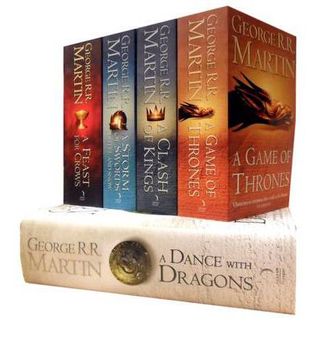
Song of Ice and Fire

This series made me step out of the traditional mold when it came to world-design. Before I read the first novels of the series, my campaign worlds had been pretty standard “European” or it had been Earthdawn (which as a game itself also inspired me a lot). Westeros was not what I found most inspiring, but the decadent and old lands of the east are very cool with places such as Astapor and Mereen. I made a campaign called the Far Seas, a maritime campaign with a lot of islands, where I put in big Jade pyramids, nomadic Halfling armadas, lost gods, fantastic cities with ancient monuments and strange magical effects. Looking at many published campaigns today, Far Seas isn’t exceptional, but it was a good step for me, and it was so popular that when I moved to another town, a frieSOIFnd of mine ran a campaign in that world. That is a pretty big compliment.
“Aggo was back next. The southwest was barren and burnt, he swore. He had found the ruins of two more cities, smaller than Vaes Tolorro but otherwise the same. One was warded by a ring of skills mounted on iron spears, so he dared not enter, but he had explored the second one as long as he could. He showed Dany an iron bracelet he had found, set with uncut fire opal the size of her thumb.”
– A Song of Ice and Fire


Dark Souls

The fantastic video game Dark Souls is a masterpiece of game design. I’m intensely inspired by the level design. The way the world seamlessly flows together and slowly reveals new secrets and connections has to be experienced. The story of the world, its mythos, and the NPC’s stories and motives are extremely opaque and are only revealed by examining all objects and if certain specific steps are taken in the right order. And in Dark Souls outcomes and decisions are permanent, so if you attacked that NPC or he died in a battle, you will have to start a new game to try a different path. This is an exploration element that I really like as well, and is an approach I’m attempting in my current D&D campaign.

Watch the show ‘Extra Play’ on Youtube play and deconstruct Dark Souls game design.

They way that you avatar’s experience mirrors your experience as a player is masterful design. The setup of many of the monster encounters is also very interesting and can easily be used in D&D.

Dark Souls II has less interesting level design (it is still great), but it is also visually very inspiring for my current campaign.

When it comes to video role-playing games, it is – in my experience – when it comes to mechanics and exploration the closest you can come to a pen & paper game. The reason is that you can approach enemies and problems in many ways, which is close to your experience in a pen & paper game.

dark-souls
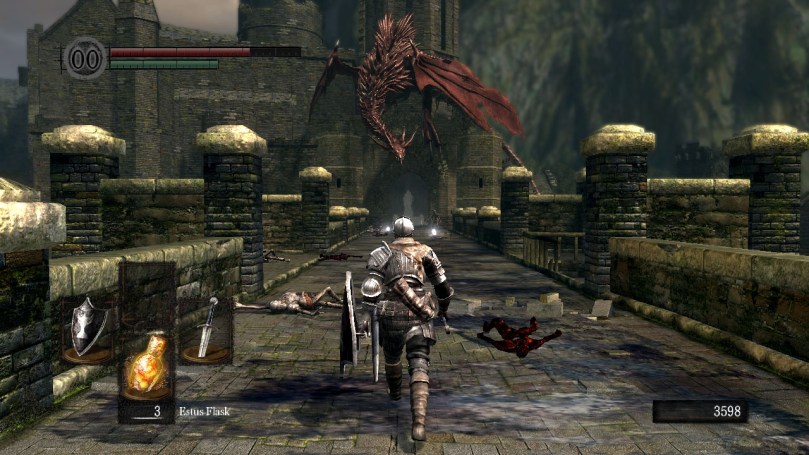
Approaching the Red Drake. The staircase on the right is a wise move.


For my current D&D campaign I’ve not fully taken the plunge into making my own version of a coherent world where the campaign basically all takes within a dungeon. I’ve more tried to let myself be inspired by the design philosophy behind it. If I were to go all the way, D&D would not necessarily be a great system, as many of the spells would need to be modified. But any system would probably need to be modified, in order for the system to emphasize the way the world and campaign should work.

 Playing at the World
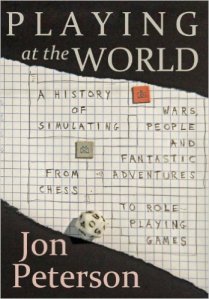
This book is about the history of D&D and the games that led to this revolution. It led me deeper into the ideas in the original D&D and made me want to go back to basics – although without going back to some of the OD&D versions of the game, as I have a preference for the smooth mechanics of 5th edition. It is a massive book (600+ pages), and you will learn something you didn’t know.

playing at the worldOne thing that I’ve taken directly to heart in both my home brew campaign and in our Temple of Elemental Evil game is that D&D originally had three core aspects: combat, exploration and logistics. Exploration is of course a cornerstone of my new homebrew. The last part I also find very interesting. I think it is quite apparent that among my players there are different preferences for these elements. Logistics is about how much ammunition to bring, what spells to select and dividing treasure. I have previously skipped this somewhat, but I will try to have it as a more intentional element, for example by using the construction rules from Pathfinder Ultimate Campaign.

It led me to buy many vintage modules online, and there are some great ideas in them as well.

“Into the dramatic structure of Dungeons & Dragons, the mode of logistics injects some much needed banality: after the suspense of exploring and the adrenaline of bloodshed, the chore of logistics, even when they border on tedium, serve as an important counterweight to adventures.” (In Playing at the World, by Jon Peterson)

The Scramble for Africa

Africa is a vast and extremely varied continent, and both its nature and

scramble for africa
Amazon naturally has all the books: if you’re interested

history is an inspiration to me. Recently I read this history of how the European Powers explored and carved up between them the many independent kingdoms and more or less inhabited wilderness of Africa. The exploration element is as always interesting to me – the hardship in traversing deep jungle and the couple of years that Stanley spent traversing the continent East to West. The brutality of the conflicts and of the rule of some of the African kings can also be used in D&D, as can the power play between the nations trying to grab as much land as possible.

“Stanley looked at the majestic brown river flowing past the tall square houses and the baobab trees. Its calmness seemed to him a kind of hypocrisy. It had robbed him of so many of his best men, including Frank Pocock, the last survivor of his three white companions. Even now Stanley felt the hollowness of his triumph. He had sailed from Zanzibar with more than 250 men, women and children. Only 108 would now return safely to their homes.”
The Scramble for Africa, Stanley arrives at the west coast of Africa

The Italian Renaissance

Italy, before it became a nation and was a collection of city states, is so full of intrigue, war and conflict that period has near limitless potential for inspiration for almost any role-playing game – but for Warhammer Fantasy Role-play in particular. As there is so much surviving art and written works from the region and period, there is a lot of potential reading to do. I just needed an overview before a visit to Florence, and I picked up The Italian Renaissance. It deals with both a few central topics such as Women and Princes and the State, and has a chapter on each of the major city-states, and for someone growing up in a modern democracy; I find it helpful to be reminded of the attitudes, government structures and social structures of other people and other times. It can add some memorable tweaks to your NPCs and campaign setting.

IMG_0386
Monument to the most feared mercenary genral in Italy John Hawkwood (Fading Suns, anyone?), who fought for Florence

“On this knowledge the Council acted swiftly and silently, for no public trials enlivened the Venetian scene, and there were no appeals. Once found guilty, the prisoner was sometimes quickly and efficiently strangled in the dungeons or thrown into a part of the lagoon reserved for the purpose, where no fishing was allowed; or hanged by one leg from the pillars of the Doge’s Palace; or quartered and distributed about the city; or buried upside down in the Pazetta, legs protruding; or beheaded – as a public spectacle – between the great pillars on which stand Saint Theodore, with his crocodile and the winged lion of Saint Mark.”
– The Italian Renaissance, on how its Council of Ten kept power through its intelligence system.


Dresden Files

The Dresden Files didn’t make it to the top-10 list, but I include it as an honourable mention, as I think it can teach you a thing or two when it comes to upping the stakes and making the stories more action packed.  The Dresden Files demonstrates that you can always kick it up a notch!7bcd5b3f4e4c8b81976032eb67030845

Board game and RPG loot from Essen

I went to the board game and comics convention in Essen, Germany, a couple of weeks ago, and I came home with a bad cold, four board games, a couple of role-playing games and some new experiences.

It was the first time I went to The Internationale Spieltage convention (or simply Spiel). It is the second largest in the world with hundreds of board games being demonstrated and sold. I wish I had been in better health, but I did manage to play a number of fun board games, and I will provide a brief review/introduction to a couple of them here. And also discuss the two RPGs I got.

Rise of the Kage

Ninjas are awesome.
Ninjas are awesome.

A stealth ninja game. It had some very cool mechanics, great miniatures and awesome flavor. I think the stealth mechanics works really well, and it plays well both with 2 and four players. Basically three ninjas have to infiltrate a location and complete a mission before the sun rises or the alarm sounds. One player plays the guard, and 1-3 players plays the ninjas. Each time they fail an action noise is generated, which advances both the time and the alert level, and allows the defending player more actions, guards and so on. We’ve only played it a couple of times, but it has depth, a lot of missions, and thus replay value, and it’s just awesome playing ninjas. If I have to point out some negative things it is layout and design of the rule book, which I think is hard to use for quick reference. The fact that the different cards you use only have two different backgrounds, when they are to be in different piles that you draw from at different times, is very annoying and finally that the design of the box lacks space for the counters.

The board with witches and towers.

Broom Service

Several of us bought this fun family game. Each player has two witches who has to deliver potions to a board full of wizard towers and dispel clouds to score points. The colour of the potions you deliver has to match the colours of the towers. There are no dice in the game, which is great. Each round each player gets to pick 4 out 10 cards, which you use to move your witches, gather new ingredients, produce potions and deliver the potions to score points. All the players have the same cards, and when the player who’s turn it is plays a card, everyone else who has picked the same card has to play it, which can really mess up your original plan. As your plans are often dependent on the sequence you play your cards, the game play is very much about figuring out what the other player’s intentions are and foiling them, or avoiding getting screwed by other people’s actions. The art is fun and attractive and the game play is simple, but has a lot of depth.

The dice that are evolving monster counters.

Light of Dragons

I didn’t buy this very deep but simple looking game, and I only played it once. It is a two-player game, also without dice, and only takes 20-30 minutes two play. You play with 6-side pieces, basically dice you don’t roll, where each face of the dice represents a monster with special abilities on the simple square board. You score points by killing the other player’s monsters, and with each action you have, you can either move a piece or evolve it to the next level of monster. You quickly realize that the way the different abilities interact in play is simply brilliant, and results in a host of available strategies. It could easily be used as a chess-equivalent game in a fantasy RPG campaign. I highly recommend it.

Two new (old) RPGs

It turns out that Bram Stoker's Dracula novel is in fact an old British intelligence report with all the really interesting parts removed.
It turns out that Bram Stoker’s Dracula novel is in fact an old British intelligence report with all the really interesting parts removed.

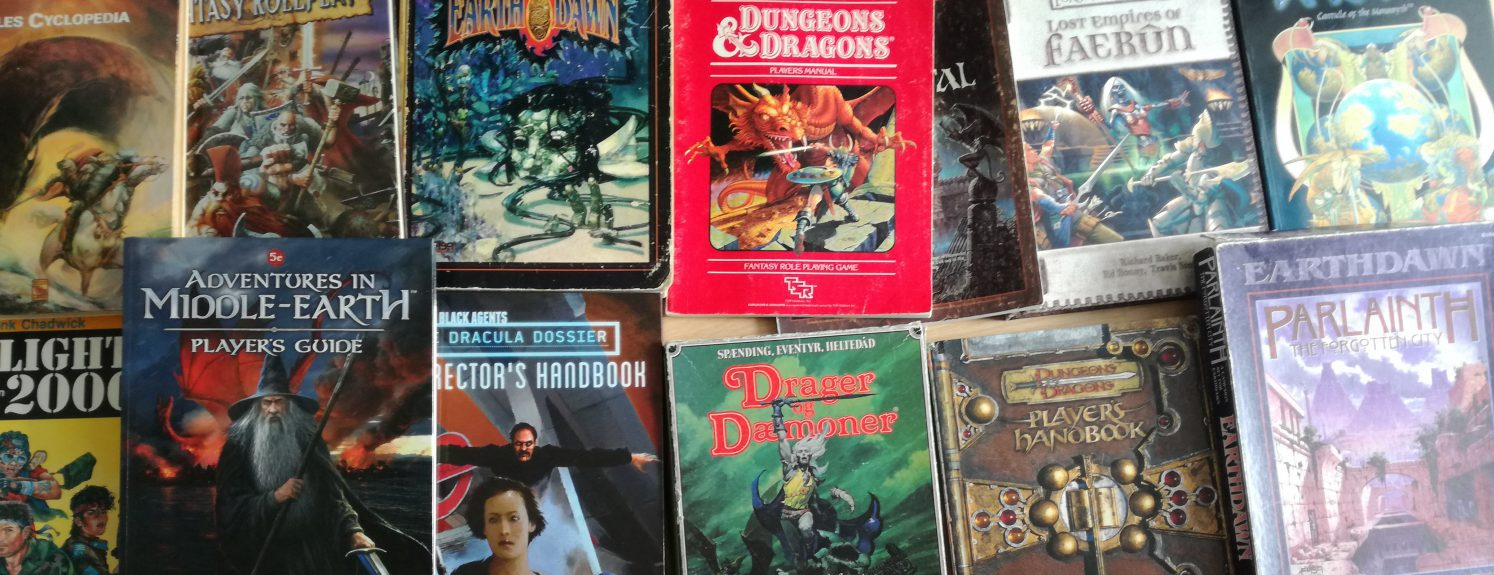
I bought two new role-playing games as well: Ars Magica (2004 for the 5th ed.) and Night’s Black Agents (2012). I know I won’t be playing them for a long, long time, but I took the opportunity to buy them anyway.

Night’s Black Agents is a thriller game with spies going up against vampires. Think the Bourne films or Ronin, but with big vampire conspiracies. Unlike the Vampire game from White Wolf, you can only play the human underdogs. The reason why I really wanted to pick this up, was because I heard the author, Kenneth Hite talk (on this podcast), about his newly published campaign, the Dracula Dossier, and it is just really, really cool idea. You should check it out (here). Furthermore, it looks like the system handles investigation much better than the old basic roleplay version of Call of Cthulhu or the White Wolf games. It would still be at least a couple of years before I project my D&D campaign to finish, but a man can dream.

Ars Magica speaks to my strong interest in history and in making long campaigns with big story arcs. But it would require a big effort from me to actually create the campaign I would want to play, and that won’t happen for several years. But the dream of a several years long campaign with every player having several characters and slowly developing their Chantry through the political and religious turmoil of the 13th century is very appealing.ArM5LogoColor

So, I found a great fantasy art book in Paris…

Front cover of the art book of Oliver Ledroit.

I was in Paris this weekend, and was recommended by my friend Adrian, who is also one of my player’s in my own group, to go to Rue Dante and check out the comic book stores there. It was a great suggestion, and I dragged by girl friend to a number of them, while looking at the great French and American comics and graphic novels (not that there is clear verbal a distinction in Europe), as the French, Dutch and Belgian artists have always made comic books for both children and adult audiences, with some stories very adult.

I was exiting a store, when my eyes fell on an art book, which struck a chord, and I open it, and I see the illustrations from one of my favorite dark fantasy comic books The Black Moon Chronicles (also available in English). The artist is Oliver Ledroit, and it turns out he only did the first few albums, but has done a number of other things since then. It was his first job as an illustrator and got it by showing his portfolio at a convention, when he was only 17.

Inside the book I learned that there is a whole line of miniatures for the setting, and that Ledroit, was inspired by the early Conan comics and has worked on role-playing games and the video game Heroes of Might and Magic

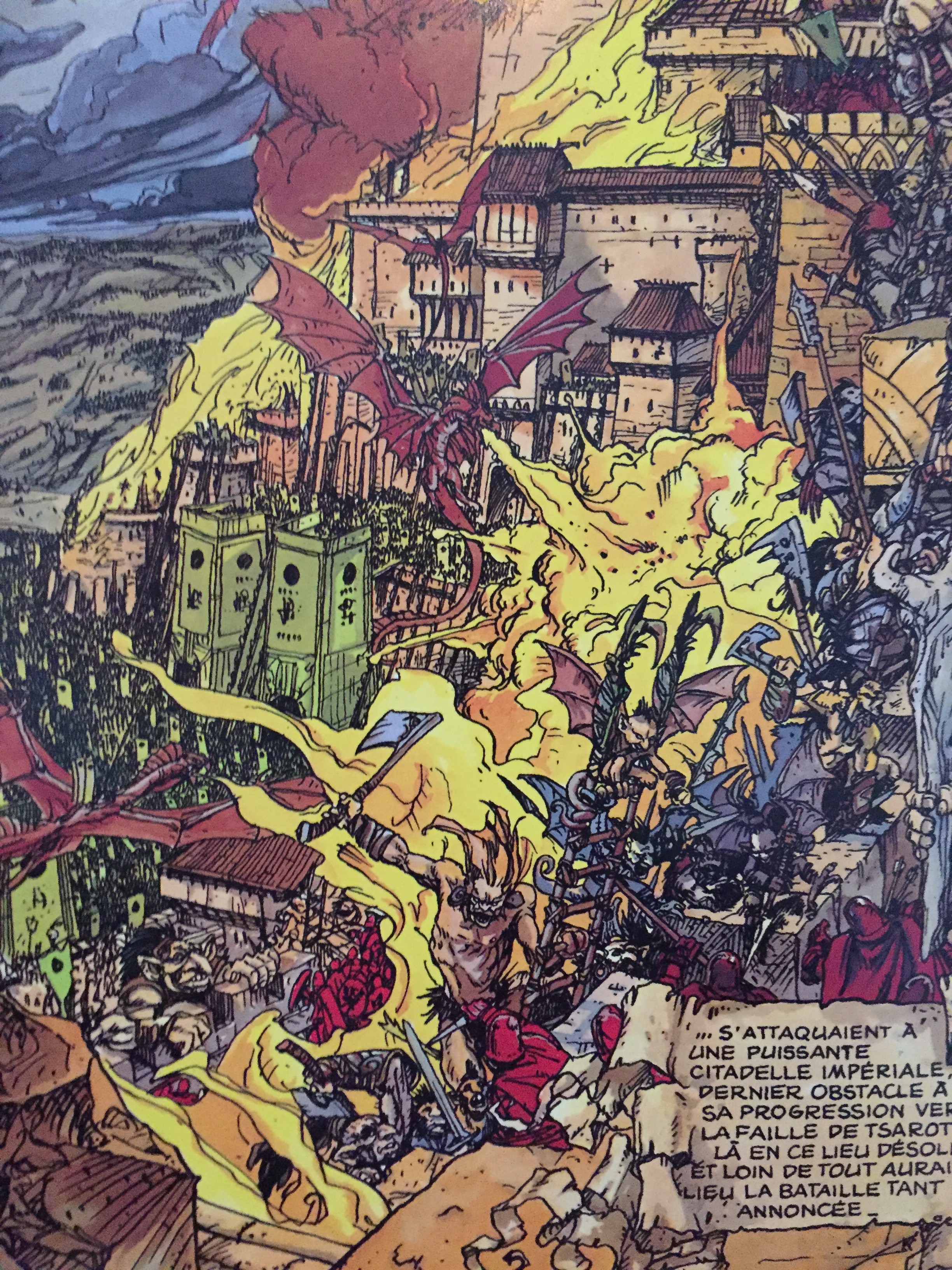
Half of one of the big double page battles, which you also see in Prince Valiant.

He has these vast tableaus of thousands of troops, and is mentioned to be inspired by Prince Valiant, which is also clearly evident.

“If you ask him to represent 5,000 guards, you will get an outpouring of millions of men.”
(author of Black Moon Chronicles, Marcela-Froideval)

I can’t say that my own games are directly inspired by these stories directly, but I would recommend them to any fantasy fan. Even after Ledroit left to pursue other projects the artistic style has been retained, and it is really epic, where the good-guy templars are cast as the bad-guys.

The art book was reduced in price from 50 to 20 euros, and was a bit of a steal, in my view.

It has also left me wondering about the French role-playing scene. It turns out the author of Black Moon Chronicles also makes role-playing games. What does that look like? What other games do they make? How big is it? Are any of them in English? It is a big market, and a country like Sweden, which is significantly smaller, has a number of very successful home-grown games, like Drakar och Demoner (which I’ve played a lot!), which leads me to assume that France must have many.

When I return from Internationale Spieltage in Germany, I will have to look into the other projects Ledroit has worked on, such as the science fiction SHA and the noir story XOCO and perhaps I will see some new RPGs at the convention in Essen.

I will conclude this post with a few more samples from the book. But it is full of awesomeness, so I recommend to check Ledroit out yourself.

It shows in his fairies sketches that he was interested in butterflies when he was young.
Character sketches for a SF universe by Ledroit.
Awesome elf character sketch for Heroes of Might and Magic by Ledroit.