Session 22 & 23: The Crystal Pinnacle

These were two relatively encounter heavy session, where the characters enter the lair of the (buffed) hag Arasekha, but sessions, where they sacrifice important things to gain knowledge that will move the plot forward.

Sacrifices for Oracle

We began the session by the well, where Xarzon, whom the paladin identifies as being a celestial, still sits waiting for them to leave, so he can use the oracle himself.

There are seven players present, so when the player of Korrick, the dwarf fighter/bard, asks Xarzon, what you must sacrifice to learn something, not everyone hears. That becomes important.

Korrick decides to sacrifice his new Ring of Protection +1 to the spirit in the well, and the huge spirit emerges from the well and answers Korricks question on the nature of the curse that afflicts his clan (more on that later).

A little later, the gnome rogue, who together with the group’s wizard stole some sort of item from the monastery the wizard grew up in, decides to do the same, but choses to sacrifice 30 silver and some blood. Obviously, 30 silver is far from enough, so the spirit snatches some of the offered life force and the gnome is deducted 5 hit points – permanently.

Both characters got some relevant information that potentially will change the future decisions they might make.

green_hag-5e
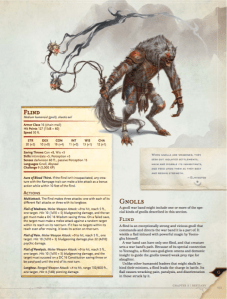
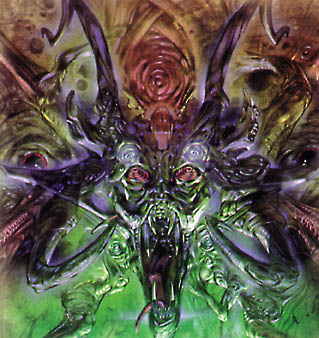
The green hag of the MM was too weak. Arasekha was a 10th level diviner, with extra HP and Lair Actions. Her older sister is worse.

The lair of Arasekha

The group then continues and find the exit to the lair of Arasekha, and when they pass through the portal, they emerge on a platform suspended more than 100 feet above the crystal forest on the side of a huge crystal spire (300 feet high). They are immediately attacked by a group of flying crystalline creatures, and they take some punishment. They dare a short rest, hoping that the witch hasn’t set an alarm, and succeed.

Exploring the pinnacle, which is a maze of hard to navigate crystal halls and corridors with multiple reflections of everything, they first find a garden of crystal plants with an elven caretaker. He is pruning the plants with a mithral dagger. They engage him in conversation, and he stalls until “his” minions arrive. Three groups of crystallized centaurs and hobgoblins charge towards the room. The elf turns out to be some form of simulacra and he shatters when hit, and the minions are engaged with fireballs and other potent magic, and fall before the group.

They push on and enter a large room where a group of crystallized hobgoblins are experimenting with the crystal. And we end session 22, ready to roll initiative.

Session 23

The following session the group fights the hobgoblin laboratory workers and a crystallized deranged hill giant. They defeat them without too much trouble and find hobgoblins immersed in a solution, which seems to expedite the growth of crystal, and an elven prisoner, who is mostly infected with the crystal, which seems to be spreading like an infection. She begs them to kill her and find her imprisoned brother.

The leader Jarn decides to try and find the prisoner, before they deal with the witch. They succeed and locate him together with two centaurs. After the jailers attack, and are defeated they make for the tip of the pinnacle.

At the top they find Arasekha, who is guarded by a couple of crystalline elves in a small throne room. A battle begins, and she summons simulacra of herself to divert their attention, while casting wall of fire and other spells. The group responds with all they have, using summoned panthers to attack the simulacra, to locate her true self. After a fierce struggle they defeat her, loot her sanctum of spells, her Staff of the Seer and a few other items, including a very finely made mechanical beetle.

The spire begins to collapse, and when they reach the portal, it collapses. The Warlock use his feather fall spell to let them escape, without having to brave the collapsing spire. When the session (and 2016) ends, the group find themselves in a crystal forest 100s of miles from their settlement.

What went well:

  • The crystal spire was an evocative setting, and with five major rooms/encounters it also had the right size.
  • The final battle with Araskeha was fun and had good features, lair actions and odd surprises in it.
  • The use of the oracle helped propel the plot forward based on player actions.

What could I have done differently:

  • I should have used Arasekhas ability to speak and act through the crystal even more to make her even more evocative and interesting.
  • Her minions at the final battle should have been just a bit tougher to make the encounter a little more challenging.


Planar travel for dummies – session 21

In this session, my players wander into the planes for the first time, and therefore I will write something on how I see the planes in D&D and how I’ve changed it for my home brew world, in addition to the normal session recap.

A couple of the issues I have with the planes in D&D are that there are so many of them, that the facts concerning the planes are ‘true’ and that most of them are infinite.

The problem with the fact that there are so many is that most characters – and thus players – will so rarely visit the same ones that they never gain any familiarity with them. The planes fail to become an integral part of the game world. In a typical campaign you will maybe visit one plane, so unless a campaign is centered around one of them – invasion by the City of Brass or the intrigues of the unseelie courts – they don’t play a big role.

sigil
Sigil is probably the most interesting city Wizards or TSR ever made, and it doesn’t exist in the prime material plane. 

But on the other hand, the planes are infinite. They must therefore have many more interesting places and beings than the prime world, which annoys me, because the prime world should be the most interesting (Sigil is in many ways a more interesting place than Greyhawk or Waterdeep). And there are known ‘facts’ about them (you can look them up in the DMG), which makes them less mysterious.


The prime world is more complex and finite and therefore more manageable and interesting to explore (as it should be), but the actual interaction with these far planes should be part of the adventurer’s lives and understanding.

My approach
To improve on this (in my opinion), I’ve made some changes to my multi-verse. The key ones are below. Others I will not write here, as my players are unaware of them, and I like to keep it that way.

earthdawn3
In Earthdawn powerful monstrosities lurk in the Astral plane, and some even exists in both planes at once.
  • First of all, I’ve combined the Feywild, Shadowfell and the Etheral plane into one and called them the Warrens (inspired by Steven Erikson), and that plane mirrors the prime plane, like the astral plane in Earthdawn and the umbra in Werewolf the Apocalypse.


  • Secondly , I’ve changed several spells to fit this, so when you detect or divine you see through the Warrens and when you teleport or misty step or whatever, you actually walk through the Warrens, where time and distance works differently. As the Warrens are a mirror to the prime world, it also means you can’t teleport across an ocean, you need a vessel inside the Warrens, which would enable you to cross the ocean faster. There are also beings inside the Warrens, many of them powerful, so you have to tread carefully.
  • Thirdly, there is not one, but several explanations to what they are and how they work – just like we can discuss the nature of the divine. The two my players have heard are: Some say the Warrens are a failed version of the prime world that the first gods discarded. Others that the presence of magical essence in all things naturally creates a mirror state.

These changes have the effect that the Warrens are relevant in basically every session and that the players slowly learn more about them.

It also underscores the main theme of my campaign: exploration. The Warrens is a place you explore and it is part of exploring the prime plane.

Also, instead of simply teleporting from one place to the other they have to travel everywhere, and have to consider if the advantage of going somewhere quickly outweighs the risk of meeting something very dangerous. This also underlines the theme of the campaign.

The session:
When the characters stepped through the portal (only 3 out of 7 players were present) they were immediately set upon by vengeful animal spirits, which they relatively easily defeated but they damaged them. The portal was located inside the Warren’s version of the hollowed tree.

They then began investigating the tortured elf who was crucified nearby and concluded that he had lost his soul. Then the Horned Devil and its two henchmen (bearded devils) were summoned and another fight ensued. It appeared that it had been promised their souls.

devilhorned
5th edition Horned Devil. A CR 11 monster taken out by 3 level 6 characters. Maybe I was easy on them?

To explain the presence of more characters and make they fight more appropriate, I ruled that the non-present player’s characters engage the two bearded devils. The three remaining characters then sniped away from a Fog Cloud and managed to banish the devil.

Outside of the tree, the woods of the Warrens were eerily quiet and unnatural, with no sun and with the great trees casting long shadows. Two paths had been marked through the Warrens, and they knew that to navigate the Warrens away from the path would require a stern focus (successful INT or WIS checks). One path was marked with skulls another with small crystals. They chose the crystal path north, which should lead to the middle sister.

After a few hours journeying through the Warrens they spot a corpse of an elf by an altar holding a staff with gems. They move away from the path to investigate, and when they get closer suddenly the path has disappeared, as has their four companions, and the elf turns out to be a skeleton holding nothing. At that point they are set upon by shadow bats and a weird sylvan creature with the legs of a hind and razor sharp teeth that sucks blood. They defeat them after a fierce battle and search the area as they can’t see the path anyway. In some ruins nearby they find her lair and a cloak woven from living plants and shadows and decide to rest.

They steel themselves and locate the path again, but they can’t see their companions anywhere. As the move on, they come upon a fight between a big dark skinned man wielding a beautiful great sword fighting a pack of very cunning regenerating wolves next to a mysterious dark well. They enter the battle on his side and finally slay all the wolves, which coalesce into one rangy man wearing wolf-skin.

malazen
Very complex fantasy series, highly influenced by Black Company, and grew out of an RPG campaign. One of my favorites. 

The man, who is named Xarzon, thanks them and they talk. It turns out the man was hunting him on behalf of a former employer, whom he has a disagreement with. He was a dangerous Dissembler – a shape shifter that can turn into multiple beasts (also stolen from Eriksons novels). He also tells them that the well has a spirit in it which serves as an oracle, if appeased correctly. He also tells them a few things about the Warrens: that they are strange beyond the vast space of the north, that the land is under some kind of curse and that the eldest of the Sisters of Sorrow dominates the trolls in her area and has made a pact with one of the Lords of the Nine Hells.

He also gives them a ring of protection as thank you, and with the loot of the Dissembler, it was a rewarding session.

Curse of Strahd – a review from a player perspective

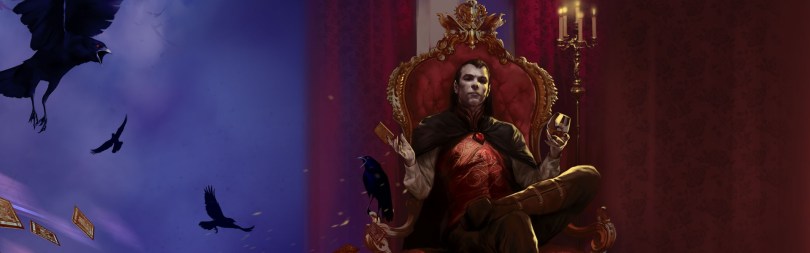
Curse of Strahd is the best published adventure that I’ve ever played in. The atmosphere is fantastic, the locations, NPCs and villains are interesting, tragic and funny and the campaign requires you to play skillfully. And I must say, played in, not played to the end, because we TPK’ed about half-way through… I will keep the review spoiler free. Perhaps you will buy it for your DM? DM’s like that kind of sucking up (you can buy it here)!

Curse of Strahd can be improved (or modified) though, and I hope any DMs who run it will consider my perspective. As a reviewer, my challenge is that I haven’t read the campaign. I’ve only played in it, and therefore my DM’s choices, awesomeness, mistakes, additions or oversights is reflected in my opinion.

17527
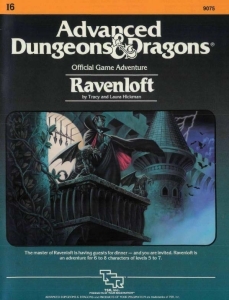
Cover of the original 1983 module.

The sand-box campaign is a remake of the original Ravenloft module. The original mainly focused on the dungeon – the castle itself. The remake is bigger and contains Strahd’s domain of Barovia and several locations and many NPCs living there.

We played with the Rest Variant – Gritty Realism (DMG pg. 267), with the change that you could use HD to regain spell slots. I think this added a lot of tension to the whole story, and helps create a more realistic timeline.

What I really liked:

  • Lore, which is important to your survival, is scattered all over. Every time you speak to an NPC or find a new location, you have a sense that there is more pieces to recover for the grand puzzle. It made the world feel important and alive, and exploration and paying attention to detail was essential.
  • It is difficult. It is hard to judge what locations are the most dangerous, and you feel very vulnerable in the beginning. We got somewhat overconfident though, which was stupid, and partly led to our demise. It feels like Skyrim without the save functionality.
  • Loot and good equipment is scarce. The supply of goods in Barovia is limited, and stuff like armor and spell components are hard to get. It added a fun dimension that we had to struggle for items even at level 5 and 6.
  • The mood is awesome, and there are some great stories and people and sub-plots in the adventure.
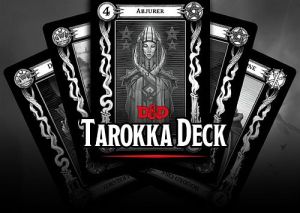
  • dnd_curstrahd_tarokka
    The Tarokka cards help define the adventure, for example who you can expect to be your ally or Strahd’s weakness. But they are cryptic ofcourse.

    The card mechanic that helps define the campaign (and was in the original, I believe) adds re-play-ability, which is good for us, as we never reached the end.

What I disliked or would want changed:

  • Everyone we met, basically said that everywhere was dangerous (and it was compared to the villagers). But after you survive the first few locations that description becomes less meaningful, and led us to misjudge the location where we TPK’ed. Only one NPC hinted that one location was beyond us, until we were significantly more experienced. I would like a little more indicators as to the danger level, because let’s face it, it will be years before we try the adventure again.
  • The Curse of Strahd (and Storm King’s Thunder) use milestone XP, and we didn’t like that. We don’t find it satisfying as players to walk up to a new location and then the DM tells us we get a level, because the adventure says so. We want to earn it. But on the other hand, it seems like there isn’t enough material in the adventure to progress to the required level the old-fashioned way. Thus, the DM would have to add a few more locations and plots.
  • I would like even more minor locations and sub-plots.

We TPK’ed, after we had visited Castle Ravenloft once to steal an important item. The heist was an evening full of tension, and I wished there were more direct hints to go to a part of the castle to complete a specific task during the adventure. It seems like many save the castle to last, but that is not necessarily the right thing to do.

One of the things that was a bit mysterious to me was the fact that one of the cards we drew led us to the encounter where we TPK’ed. At 6th level we were completely outmatched. And I mean completely. We were all dead at the end of round two. We may have missed something obvious, but I’m not sure directing us there, to something that is clearly evil (and we are mainly good guys), and expecting us to come out ahead, is good design.

We only saw a small portion of Castle Ravenloft, and I assume there is a lot of interesting material in there.

We will try again…

After our wipe, we talked about picking the adventure up again after a couple of years, and perhaps starting at level 5, with the initial elements of the story completed, narrating that part together with the DM, and drawing fresh cards. I know for sure that I would like to return to Castle Ravenloft and face the Lord of Barovia.

For now, though, we’ve begun a game, where we play low level mobsters (or petty criminals who know some mobsters, really) in Warhammer Fantasy Roleplay in the glorious city of Luccini. It is going to be great fun!


Double feature: A dragon surprise…

So, being a dad and a DM, leaves less time for prep. And obviously, prep is more important than the recap and the blog. But I will keep at it, but the recaps of the latest two sessions will be short and to the point.

lazy_dm_cover_340wI’ve been looking into The Lazy DM (Lazy DM download), and there are some very good tips, but aren’t fully applicable to the kind of campaign I’m currently running. The kind of depth that I’m looking for in the history of the world they slowly uncover simply can’t be extrapolated from a few notes and improvisation (I can’t at least). It requires a bit more prep.

I did one thing in session 19 that I think warrants a pat on the DM-back, and that is letting go of prepared stuff, in favor of moving the plot forward.

When the PCs finished with the mine and returned to the settlement to rest, they discussed what to do next. I had already cut out the attack on the goblin tribe nearby by having the other adventuring party deal with that threat. That also reinforced the meta-theme of colonizing a new land and dealing with the natives. It is brutal, and interesting, how easy the dilemma of wanting to build something in a new land, but faced with enemies and diverging interest, leads to morally questionable choices. In any case, I had mapped the goblin lair and made a few rooms, but they were already too high level, and I would rather follow other, and more important, plot threads.

I also clearly said that the Kuo Toas could be dealt with by others as that adventure also wouldn’t push the plot(s) forward.

But back to the recaps.

Session 19:

The group explored the umber hulk lair and the tunnel from there that lead down to a natural cave, where the ancient miners had begun digging. From that cave they found the first shaft, which they entered the complex through.

0fcf9a3b039cf78b7ab1b984c1a04958
The dragon simulacra had less dangerous breath weapons and only AC 17. 

Finally, they went down to the automaton storage via the unexplored elevator. The automatons didn’t attack, and the room led to the vault. The vault was protected by a security system, including an automatic portcullis, a very intelligent magic mouth that shot frost rays from its eyes and two dragon simulacra of metal that attacked when they tried to pick the lock to the vault.

They succeeded in dispelling the worst of the trap and rapidly killed the simulacra (the damage output, when the party is lucky, is insane). Inside the vault they found their first platemail, a few magic items, including an axe made by giants, and a lot of knowledge. This included letters between two elven sisters and a story about a curse put on an elven family by giants.

Having cleared the mine, they returned to the settlement and spent a month and a half of down time. In that time, they returned to the mine with a few dwarves from the settlement and made an anvil in the mine, so they could setup their own smithy and the druid awakened a couple of beasts to help protect the settlement.

Session 20:

Of the four most interesting options: going after the remaining hags through the portal, visiting the Colourless Bridge, exploring the ruined city and exploring Fort 25, they chose the first.

Before they left, someone scried on the party, and Welk, the wizard with a weird item, knew that to be the case (for some reason).

After the harvest, they returned to the lair of Kinsira, but went a different route, and found a devil trapped in an old building with magic. They decided it would keep until they returned.

When they approached the huge tree stump, they noticed webs in the area that would warn anyone inside of their approach.

Inside the tree, there were apparently giant spiders, and something spoke to them in draconic, demand that they leave. They tried to intimidate it into submitting, but they were unaware that the creature behind the voice had been paid by the two remaining hags for protecting the area.

green_dragon_wyrmling
I liked the idea of having a quite mercenary young dragon, who ran into more dangerous adversaries. 

The spiders eventually attacked together with some ettercaps. At the worst possible moment, for the group, the young green dragon attacked, and its breath weapon drained a lot of hit points from the team (42 to be exact). Unfortunately for them, I rolled a 6 on recharge next round, and gave them another breath, but couldn’t cover them all, and it could have ended in a TPK, but the characters still standing responded with a wall of thorns and a fireball, and when the dragon failed to fell the mighty half-orc fighter the following round, it submitted to the stronger adversary.

Back on their feet, they questioned the dragon and learned a couple of things, including the facts that the eldest of the hags lives in a swamp to the south and the middle sister lives in a crystal forest to the north, and that they are called the Sisters of Sorrow. The group argued about whether to make a deal with this evil dragon about staying there as their ally, but they ended up banishing it, and hoping it will stick to their deal.

Finally, they passed the portal into the Warrens. Inside they found a tortured elf and was almost immediately attacked by animal spirits of beast that Kinsira had conducted her experiments on.

Roll initiative! 

Session 18: The Battle against Ku’ud

In the previous session, the characters burst in on the sentient automaton Ku’ud, and we began the new session, before they made a decision on whether to follow his order and show him the way out, which might disrupt the power balance in the region, or fight him.

Ku’ud was obviously dangerous, and I thought I had made a suitable challenge for a large level 5 party. As we had a couple of people who couldn’t attend, and I was worried that they might feel pressured to go with the ‘show him the way out option’, I gave them the option to run the session as a flash back, and let them go through the unexplored part of the dungeon, and before they left, flash forward to this important decision. They opted to stick with the moment.

The group talked more with Ku’ud, who was walking towards the exit, and trying to make up their minds on what to do, when Welk, the wizard of the group, began casting an identify spell to see if he could learn more. Ku’ud demanded that he stopped, but also got curious, because he knew magic. He ordered the wizard to tell him what he knew, and dragged him back to the throne, where he began questioning him.

Ultimately, Jarn, spoke with his advisor, the warlock Abbott, and made a decision. He asked about his understanding of ethics and demanded that he made a promise to learn of morale and ethics, before he could show him the way out. Ku’ud responded that nothing could compromise his decision making, which made Jarn attack.

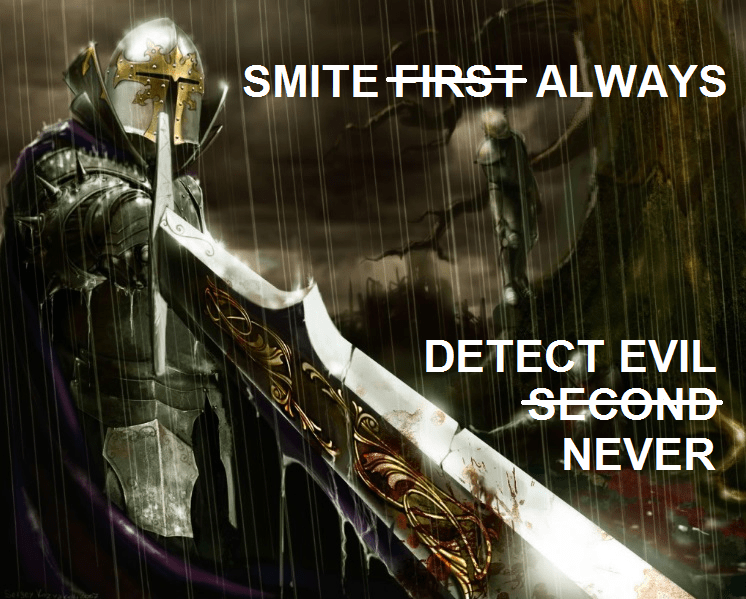
paladin-smite2
The damage spike of the paladin smite ability can surprise me, but in this encounter they would have been hard pressed without it… And I’m very happy that in 5 ed. the Detect ‘Evil’ has been change into detecting celestials and devils and such. 

After a short battle, they defeated Ku’ud. Single boss encounters are hard to make. I had given him a couple of henchmen, but for verisimilitude and to ease just a little bit, I let the two fighters deal with them, as their player’s weren’t present, but had been there when they entered the room. They piled on Ku’ud, and Jarn unleashed his new found Smite ability. The wizard cast a ray of enfeeblement and managed to roll so well, that I couldn’t even use Ku’uds shield spell to ward it off. In the heat of battle, I forgot his advantage on saves (magic resistance), and wasted a round casting dispel magic (which the wizard countered), and in round 4 it was over. Jarn, as their only fighter-type, was down to 2 hp in round 1, and it could easily have tipped with a lucky roll or two.


It turned out, that Ku’ud was semi-biological and crafted with high order magic, and very advanced. They found a bit of loot and a spell book.

umberhulk10
This Umber Hulk looks dangerous! Awesome art by Andreas Håndlykken. Better than the MM. 

After this epic battle, they went back to the middle of the mine and found an ancient shrine to the elven god of craftsmen. Inside the shrine they were attack by two Umber Hulks, and came close to a TPK. They were only four characters left, but still two CR 5 opponents were more dangerous than one CR 10 – mainly due to the incapacitating glare with a DC 15 Charisma save.

Next time, I’m confident that they will find the exit from the mine and return to the forest and begin exploring again.

I will upload the stats on Ku’ud on the blog later.


Session 17: The sentient automaton

Last session the group found the magic machine that once powered the large iron mine they are exploring (and are caught in, due to a collapsing tunnel).

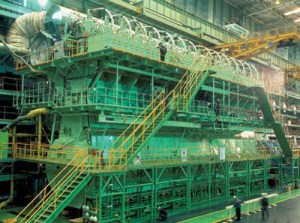
We began the session by rolling initiative. The magic machine is huge. Like the engine on one of the newest massive container ships. That means multiple levels of machinery, levers, crystal dials and buttons. And it was guarded by six automatons. Three medium sized ones that also could use an arm as a flame thrower, and three small spider-like automatons (similar to one of the types you can encounter in Skyrim).

180px-sr-creature-dwarven_spider
Drone from Skyrim

The small drones were able to conjure a defensive shield (as the shield spell), which made them hard to hit. We only had four players at the very beginning, but luck was on the side of the players, so they managed the battle, without anyone going down.

I think it was a fun and well balanced encounter, with both ranged and melee attacks and saves being made to avoid the flame throwers. I’ve become a fan of abilities with re-charge, because you can add quite powerful abilities, that the players are scared of, and the randomness of the recharge keeps them guessing if the monsters can use them or not.

engine_2
This is the kind of size of the machine I had in mind. 

After vanquishing the automatons they found a second elevator down and the mine path continued to what could be an exit. The group decided to try and power up the machine, and after four days of work, they succeeded (it was a DC 20 Arcana check per day). I rolled random encounters for 8 hours per day, and they got one that I waived, because it was easy, but the half-orc Arak and their range/paladin leader Jarn, ran into a Black Pudding, and Jarn’s splint mail was basically destroyed.

Players may hate that situation, but I think it adds a fun tactical dimension, and force the players to change the way the play for a while. For example, Jarn’s ability to tank monsters is significantly reduced, until he finds a new armor. It also makes a CR 4 encounter fearsome, without endangering their lives (Jarn was at 2 hp at the end, but they would have won…)

After powering up the machine, which was by systematic trial and error. They could activate the elevators. They scouted the one by the machine with the Warlock’s clairvoyance ability, and saw a large room below with many, mostly empty, storage pods for automatons, and then moved on to the one hidden inside the foundry (see previous session).  

Beneath the foundry they found a storage room for magical ingredients and a few spell scrolls. It also had a door and behind it another elevator. As they couldn’t see anything at the end of the elevator, except a tunnel, they decide to take the elevator down. Half-way they are asked for a password, and as they fail to comply, an air elemental is summoned into the confined space, and it attacks.

The air elemental can use its Whirlwind attack to throw people within its 10×10 foot space around, with damage dealt to characters hit by another character. It was not quite as dangerous as I had hoped, but with more failed saving throws, or a full party, it could have been a real mess!

At the foot of the elevator, there is a tunnel which has been collapsed on purpose. The druid figures out that he can shape shift into a giant badger and burrow a way through. Inside they find a couple of large rooms, with a 9-foot-tall automaton (golem basically) with crystal eyes and a slim elven-like rune covered metal body. The floor and walls of the room are all inscribed with text, and there are signs of a workshop. The automaton speaks to them, and tries to figure out who they are, and demands to be escorted outside, when it learns that they are able to go out.

The automaton is clearly sentient, but also not quite right in the head. It speaks to itself and has created a couple of naïve automatons itself. It also has valuable information. It tells them that the mine belonged to the Sestial family, that the Bones of Sarakhon are the enemy and that it intends to fight them. It has no sense of time, and appears to be quite bossy.

We end the session here, with three (I think) characters advancing to 6th level. The final meeting with the golem was great, because they can’t figure out what to do. Is the automaton dangerous to their settlement and future in this new land? Will it become a major threat? Or will it simply create confusion and damage their enemies? They can tell it knows things that they find valuable, but how much can they get out of it? And if they decide it is too dangerous to let out, can they actually defeat it, because it looks pretty tough? All are interesting questions. They also speculate a lot about, why it is there? Was it imprisoned and why was the mine abandoned? Does the automaton have anything to do with it? 

Next time, they will have to resolve what to do with the automaton, and perhaps explore the last of the mine. I at least except it to be the final session inside the mine. Then we can get back to exploring the great forest above, and perhaps beyond…

Session 16: Discovery of the magic-engine

So, I’m a bit behind… We had session 18 last Wednesday. We also played a evening of White Plume Mountain, which I hope to write about… but I’m starting in a new job, and with a 6-month old at home, there is a lot less time and energy. My main hope and priority is to continue the development of the campaign.  I hope I can keep up the blogging!

Our first session after the summer holiday, was a solid session with a couple of fun encounters and some clever use of spells, but wasn’t a session that pushed the plot much further. Therefore, this recap will also be relatively short. From a challenge perspective, the encounters could have been ramped up a bit, to put the big group in real danger, but on the other hand, I don’t mind that every encounter doesn’t feel hard. It puts the hard ones into perspective.

One of the things I really enjoy is that the players and character begin to get some clues about the history of the world they are in. They can see for example that this magic is very advanced, compared to what they know, and they begin to speculate about the civilization that came before – sometimes correctly, and sometimes not at all. [More on that in session 18…]

Descent…

The seven adventurers descended deeper into the mine, instead of moving through a horizontal shaft at their level. They ended up in a large cave, where couple of piercers dropped and a Roper ensnare three characters, and started to reel them in.

Monster_Manual_4e_-_Roper_-_p222_-_Warren_mahy[I had placed the roper in the ceiling, but even so, they managed to get through its almost 100 hit points in short order.]

The druid was the final character, who was just about to be eaten 40 feet above the cave floor, when the Roper was killed, and the wizard had cast levitate on the druid, so he didn’t fall.

They explored the big lake in the cave and found a smaller cave with a dragon skeleton. Initially, only the gnome rogue and the druid went to the cave, and the rogue left in a hurry, when the dragons vengeful spirit (poltergeist with extra HD) attacked him. They went in the whole team wearily, and I rolled miserably, so the spirit was also killed, and the small dragon hoard taken.

From the cave, which was semi-natural, but with some signs of mining activity, they finally began moving back in the direction they believe they entered the mine from. The tunnel led to a large gate, which was protected by a double ward (dispel magic and fireball). They managed to set off the ward and move through the gate before they recharged. Inside they found a small foundry and the workshop where they built all the automatons they had encountered, including two new guardian automatons, which they defeated. Inside the final part of the workshop, they discovered a dial, which was like the lock on a safe. The gnome first failed to open it, and the room was filled with a Cloud Kill. That gave some serious damage, but they moved the cloud with a Gust of Wind, and decided to let the rogue try again (and he rolled nat 20). The lock opened a secret door to a room with an elevator, but it wasn’t powered.

The group figured that something must power the magical mine carts and the foundry and everything, and they were right. They rested in the foundry, Abbott, the group’s warlock talked about trusting Jarn, and Jarn explained how his order views users of magic, who have no code or creed or control, as witches that needs to be destroyed.

Ainitiativefter a full rest, they moved on, an entered a room with a giant machine, guarded by more metal automatons.
Session 18 begins by rolling initiative! (which I view as the best way to start a gaming session)

Between Realism & Fantasy: my dungeon design

As I was working on the Iron Mine dungeon for my own campaign, and reading various things online (including the AngryDMs articles on his MegaDungeon) I decided I wanted to write something about my high level dungeon design approach, and some pet peeves.

Obviously, every dungeon should have a story, and a history, which explains why it was built, what its function was and what has happened with it since it was built. Knowing these things will help you add the small details that makes the dungeon come alive.

Two Extremes

To me, there are two extremes of dungeon design – the realistic and the fantastic – and a

Deathstar_negwt
It is hard to explore the Death Star room by room. And all the random encounters with Storm Troopers would become quite boring. 


whole lot of variations in between. Another way to look at them are complete dungeons versus ‘just the cool bits’ dungeons. An example of a complete dungeon would be Temple of Elemental Evil, where every little corridor is described and the Death Star, where we just see a couple of important areas, would be a ‘cool bits’ dungeon.

Gary Gygax leaned towards the realistic and complete dungeon. His gaming and inspiration starting point was actual medieval castles, and therefore many of the early published dungeons look somewhat like something you could find in real life – an example would be the Moathouse in The Village of Hommlet module.

Mausoleum
The catacombs beneath Paris has 2 km of tunnels (which isn’t counting the rest of the lime stone quarry) keeping the bones of 6 million dead. Good place for a lich…

The biggest problem, in my view, with many of the old school designs is that many of the dungeons are actually far smaller than the “dungeons” – in the broad sense – that you can find in real life, and Gary’s sources of inspiration are focused on medieval Europe, which limits the imagination. However, humans have built vast fortresses, palaces and constructions that dwarf what the early designers came up with for D&D. And until the Underdark became a thing, the natural caves in the real world were far more extensive than e.g. Keep on the Borderlands. Real world strongholds are also often very complex buildings with many complicated passageways and interconnecting rooms.

Furthermore, it is obviously not realistic to have 5 goblins living 20 yards and two doors away from a ferocious owl bear. Would you be living in an apartment if there was a wild bear living a couple of apartments away… even if you had a spear?

The influence of the real world architecture has also prevented many designers from actually thinking about how things would look in a high magic fantasy world. A castle is designed to take as many lives from the enemy as possible, while protecting the people inside from the attackers as much as possible for as long as possible. Therefore, you typically only have one or two access points from the ground level and towers from where you can better attack the enemy. But if you are a wizard who wishes to create a flying citadel using a castle seems to be a terrible design. Why would you want towers and battlements on your Citadel, when you might as well carve out a big rock with whatever you need. It would be much safer from dragons and armies of knights on griffons.

In my current campaign I’ve tried to think more about this for current and future dungeons.

The Published Designer’s Constraint: paper

The issue for designers who have to publish their stuff is that they are limited by the medium: for example, the paper size and the number of pages you can publish limits the designer. That seems to be one of the reasons why Gary G. cram so much stuff into each level of the Temple of Elemental Evil. Obviously it is also fun that every time you open a door to a room there is something interesting.

The designer also has to be able to communicate his vision with a map and text, which can be quite difficult. At home, you don’t need to explain to other people in text.

Your GM notes only needs to be understood by you. That’s a big advantage.

1929306_6520803106_6434_n
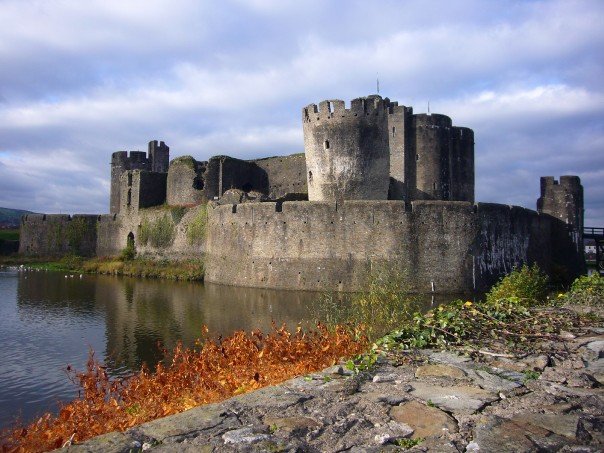
The beautiful Caerphilly Castle. A big dungeon, but I wouldn’t want to use it as a flying Citadel.

The realistic dungeon just doesn’t seem Fantasy-like to me, when you play a high fantasy game like D&D at least. With massive magocracies and enslaved giants, why would you build those tiny structures. As a lich, with endless amount of time, I would build something more imposing than Caerphilly castle in Wales – even though it is very grand in real life.

In your home game, if you want to make a big fantastic dungeon in a ruined city, you can make sections of the dungeon and cut out the boring parts. If your dungeon has a massive slave pit, make one big encounter against the slave masters and their pets, figure out how it connects with the rest of the dungeon, and then simply narrate the rest of the trip there.

The Iron Mine

Gates
Build it bigger! These are the Roman gates to Florence. Why make a lousy 20 foot gate, when you can make it 50 feet tall?


For the Iron Mine in my campaign I used the approach I’ve described. The site has a historical background and fits into the world, and it has a twist, that I can’t reveal here. But it relates to a couple of the greater narratives in my world. For example, last session they found the foreman, who had locked himself up in a room and killed himself. The question is why?

The mine has been worked by the elves for perhaps centuries, so it wouldn’t make sense to have one page of graph paper with some 10×10 corridors and a few rooms. Therefore, I made several sections of the mine, connected with tunnels that were 30×30 feet, and hundreds of feet long, and explained to the players that there were numerous small side corridors, shafts and tunnels, which their characters would be looking into and checking out superficially along the way as part of the story, but that we would only go into full dungeoneering mode, when they arrive at significant parts of the dungeon.

Each section I made is sort of a mini-dungeon by itself, with typically 3-5 separate locations/rooms, and the sections function and history is incorporated into the overall backstory of the dungeon. And each section has its own map. The map connecting the sections is basically a flow-chart.

Some of the advantages with the approach are:

  • The mine seems like a more grand, fantastic and scary place, in my view.
  • The dungeon ecology becomes more realistic. The eco system comes more alive with more realistic space.
  • There is room for wandering monsters, as the players will never explore it all, and things can move around them, without the party noticing.
  • Time becomes more realistic. The characters have to move carefully hundreds of yards between points of interest, with resulting consequences for spells, light sources and resting.
  • Each section is easy to grasp by the players when they get there and I can explain and draw it quite easily.

When my players get deeper into the Iron Mine, I can write more about how I work with stories in my dungeons.

This is what I see as at the core of my design philosophy. Let me know if I’m off the rails, or what else should inspire me.

AD&D-Dragonlance-Dragons+of+Desolation+-+9139+DL4
Flying castles against dragon armies seems to make very little sense. 


WTF is that? And Tremors… Session 13

The session evolved around exploration of the road to the site of iron ore the players heard about from the elves. It ties in with one of my story-lines, which is the development of the settlement, from very vulnerable to a strong permanent settlement.

The game started right off the bat with initiative rolls for an encounter with two Displacer Beasts. They wounded the characters, but were overcome. I enjoyed that they met a creature they faced before. Meeting one Displacer Beast was a nasty surprise at level 2, but two were manageable at level 4-5. It demonstrates that they’ve advanced in power, which is always a nice feeling as a player. If I had rolled that four Displacer Beasts had shown up on the encounter table instead, it would have been an entirely different kettle of cats…

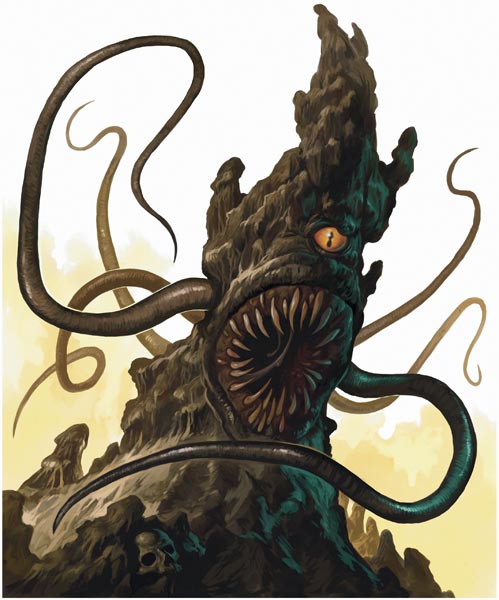
After some much needed rest, they continued moving south along the ancient road, and came across an ancient watch tower, surrounded by a low wall. Wisely, they decided to scout the place, and north of the ruin they found a tunnel, made by something fairly large. Whatever it was, they opted to draw it out, and using the bard’s bagpipes, the monster was drawn to attack. The monster was a homebrew creation; a large creature I named an Amoured Maw:

“It is the size and about the same shape of a rhino, but with shorter clawed legs, covered in hard, dark reflective scales, has a head that splits wide along its entire length into a teeth filled jaw, while the four fleshy tentacles growing from its back contains its sensory organs, as well as having nasty hooks on them. The Maw can burrow, but doesn’t do it fast enough for it to have a burrowing speed. It is an excellent climber though, using both its clawed feet and tentacles.”

The origins of the creature remain obscure to the characters, so it shall remain obscure here as well. It turned out to be a surprising, but not overly dangerous, battle for the group. The surprise was its reflective carapace (an ability the mighty Tarrasque has), that sent one of the Warlock’s spells back in his face, and the general toughness and damage output of the beast. The whole description and the reflected spell among the very first attacks, gave a nice ‘WTF is that?!’-moment, which I aim to have in this exploration focused campaign. But naturally, being 7 characters, they overcame a single monster, and went back to the tower, after figuring out that its lair was inside the semi-collapsed basement of the tower.

The tower itself was just a shell, but inhabited by 15 Stirges. They overcame a third of the

cong345a
This is pretty close to what I imagined the ancient roadside watch tower looks like. 

Stirges with a fireball and took a bit of damage while dealing with the rest. I had hope the party would go to the tower, clear it of Stirges, and camp there, setting them up for a night time encounter with the Maw, but they were smarter than that (which is good, I gues…). The players did note, how the tower is a good site for rest between the settlement and the iron deposit.

The next couple of days the kept moving south towards the site of the iron deposits, and close to the location, they discover a small lake, with a ruined villa sitting on its shore. Imagine a large more or less ancient Roman style villa left in a forest for many hundreds of years. Moving closer, they noticed some weird round areas of disturbed ground.

Tremors in the ground…

tremors1
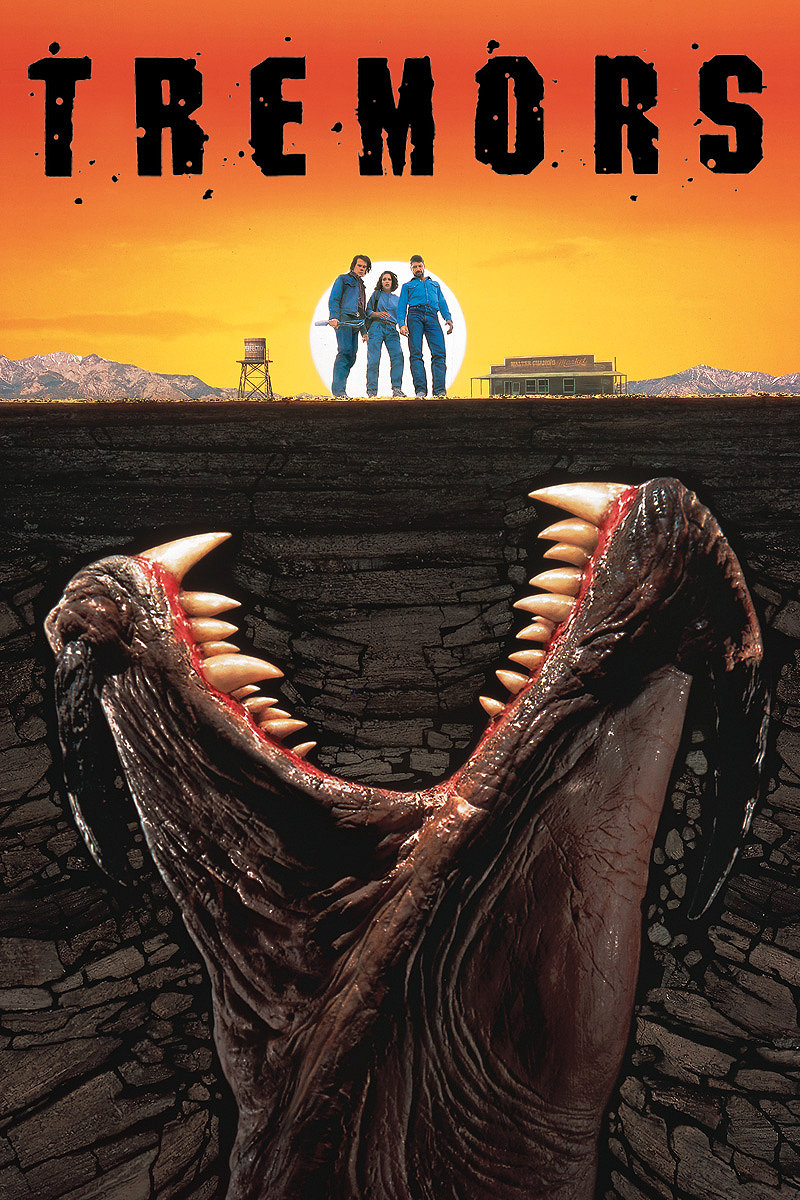
The Corpse Worm is obviously inspired by the horror b-movie Tremors. Which I thought was quite scary when I was a kid in the early nineties. 

Just outside of the villa a Corpse Worm attack. A huge monstrous worm (but smaller than a Purple Worm), which smelled of rotting meat and had leathery skin, burst out of the ground. It attacked Weylin, the druid, from below and snatched him, and the next round pulled him down to its watery tunnel below. Jarn, jumped after (and rolled a crit). A chaotic battle ensued, with Jarn struggling down the collapsing hole the worm came through, trying to kill it, before it disappeared with Weylin, and the others trying to hit the beast with ranged weapons and magic, illuminating the worm with faerie fire, or helping Jarn getting back to the surface, before the shaft collapsed above him. Weylin manages to escape the jaws of the worm and activate his Staff of the Woodlands and summons a wall of thorns in the narrow water filled tunnel he is trapped in. The combined damage slays the worm, and Weylin finally grasps Jarn’s hand, who can pull him back to the surface with the aid of his companions.

Despite their wounds, they afterwards decided to search the villa, and they (surprise!) find a half-flooded cellar below. They enter the cellar, and soon Arak – the half-orc – falls through a floor into another tunnel, but his comrades manage to get him out, before anything emerges.

Next time, we will see if there are more worms? And what the iron deposit site actually looks like.

Evocative Combat:

I think this session was dominated by a couple of fun and memorable encounters. As I’ve mentioned before, I try to modify and create monsters for around 2/3s of the combat encounters, because I want my seasoned group to never know what they are facing, and rarely know what they are vulnerable against or resists. Fortunately, D&D 5th is very easy to mold and change, as long as you don’t care about encounter xp and difficulty too much.

The encounter with the worm was the kind of combat encounter that I really like. A fluid scene in multiple dimensions, and not simply minis being moved tactically around the map (which also has its place, and is fun). It can be difficult as the DM to clearly give everyone a sense of what is possible, and where everyone is, but having only one opponent makes it a lot easier to manage – and combat happens quickly compared to moving minis around. I may not have followed the ‘say yes’ rule as much as I should, but I think it had tense and fun action – and a real danger to one of the characters.

The Wall of Thorns spell also showed itself as a ‘getting out of deep trouble’-spell.


Goodberries and Mayonnaise

The group spent one month in the settlement, working on down-time tasks and talking to NPCs, while eating Goodberries drenched in mayonnaise.

To make the timeline move forward and to make sure that the characters have a more natural progress these interludes are important. Often, players have this sense of urgency, and think if they don’t spend every day adventuring, somehow they are going to miss something or become penalized in the story, for example by bad guys spending that time plotting against them and building their strength. I hope they will learn that that is not the case. As one of the goals of the campaign is for the characters to become older and the settlement to grow around them, spending down time, building a home, or a base of operations even, and gathering resources is important. It is also good from an overall pacing perspective. And lastly, I dislike characters going from 1st to 20th level over a few busy months. That just seems quite unrealistic – if such a word can be used for fantasy roleplaying.

A significant element of the 12th session was the practical issues when you are an adventurer in a small settlement, on a far off continent, with no trading partners and everyone being self-sufficient: How to get food, build a shelter and craft better armor and other stuff?

Mayonnaise_(1)
A liter of mayo is about 9000 calories, or 3 times the need of an adult male. 

The adventurers decided to solve the food issue with the Goodberries spell, which can sustain their entire group every day. The joke was that since the have the wonderful Alchemy Jug which can produce 2 gallons (8 liters) of mayonnaise every day they would be supplementing their diet of a single daily goodberry with a liter of mayo – each – which turned into jokes about offering presents of mayo and goodberries to the honoured elven guests and what the characters would look like when they started adventuring again after eating mayo non-stop for a month. Jokes aside, the Alchemy Jar continues to be a valuable item, as it can produce a lot of valuable liquids, when you are in an isolated settlement, such as honey, wine and vinegar.

There were a few key events and discoveries during the session:

  • It was a surprise to some that their gold and silver was worth very little in the settlement, but that everything had to be bartered for. I hope it provides a different perspective on what is valuable to them.
  • The group read the books they discovered in the hag lair, and the wizard, who wisely picked cartography as a proficiency, was able to determine the approximate location of some of the places named in one of the books, including the Colourless Bridge, which is inside the forest, and they learned the name of the ruined city nearby: Ivanith’laril. They could also see that the elves had made war against the Bones of Sarakhon and that they were undead.
  • The druid learned the local elven dialect, so now the risk of confusion is minimized when parlaying with the elves.
  • iron-ore-lump-333
    Iron ore: almost as valuable as gold at this stage in the campaign.

    They wanted to craft a full plate armour, but were horrified at the time it would take them to craft it themselves, so they made a deal with the dwarf family living in the settlement. The dwarves would help them craft 2 full plate armours during the coming year, and they would assist exploiting the iron ore deposit that the group had learned about from the elves, and in return, the dwarves would get 1500 gp. and their iron bars. The gold they could send back to their clan, who could use it to get more dwarves to migrate to the settlement.

  • A trio of goblins scouts snuck into the settlement, but the characters captured one and killed the rest, and learned of some of the other goblin tribes and that their own tribe the Red Fangs, had an ettin ally and powerful goblin witches. And more importantly, that there is a town at the edge of the forest where the goblins trade with the hobgoblins of the plains.
  • The elves visited with an ‘official’ delegation, and they told them the location of the site with iron and that there is an ancient road leading there. They also learned that the edge of the forest was about 400 miles from the settlement, and that the area around the Colourless Bridge is haunted.
Displacer_Beast_MM_4e
Roll initiative losers!


At the end of the session the group began their journey south through the forest along the ancient road, and during the first night Sir Jarn was jumped by a couple of Displacer Beasts – which means next session begins by rolling initiative.

I actually love starting a session with combat, and in one campaign had the rule, that all sessions started with an initiative roll, potentially as a flash forward scene, because the combat really gets the players focused right away.

Positive aspects

A couple of things worked really well this session:

  • Letting them research old books and speak to the locals and from that begin to fill in some blanks on the vast hex map is fun and tantalizing. The only down side is that every time I bring up a new location they haven’t visited, half the group immediately wants to go off and explore it right away… But that is also kind of the point of the campaign!
  • The moral and societal choices that happened when the Europeans came to the Americas are beginning to show themselves. For example, it is clear that the goblin tribe nearby will never let them farm and prosper in peace, so at some point they have to be destroyed, even though they are the natural inhabitants in this place – the situation is very similar to the one describe in this podcast  Apache Tears between the Apache and the Mexicans and U.S. settlers. Furthermore, the friendly elves certainly don’t mind some powerful allies against the hobgoblins, as the settlement has a minute impact on the forest, but what happens years down the road when more and more settlers arrive?

Negative aspects:

It isn’t negative as such, but the reality is that if you have a large group doing down time and NPC interaction in a settlement, the actual ‘screen time’ of each character is reduced significantly. As a change of pace the session was good, but we all prefer more action and adventure.